The other afternoon, I was trying to take a nap.
I had worked late the night before, and dinner was still several hours away, and I had achieved that particular state of adult exhaustion in which closing your eyes for 20 minutes begins to seem less like a luxury than a medically indicated procedure. Unfortunately, the universe had other plans.
First came the whippet who lives down the hall, galloping outside my apartment and then, as he often does, failing to account for the slickness of the linoleum. There was a skid, followed by the unmistakable sound of dog meeting trash cans: bowling ball, pins. Then two neighbors began, ironically, shouting outside my window about which of them was less considerate about the amount of noise they made. Then I remembered that the ceiling fan has one speed at which it rattles faintly but insistently, so I got out of bed, yanked the chain and sent the blades spinning faster.
Finally, I lay back down. The apartment quieted. My breathing slowed. I had just begun to lilt toward sleep when my phone buzzed.
“We miss you! You deserve something sweet…”
It was an ice cream chain in a city where I no longer live.
There is something uniquely irritating about being emotionally pursued by a corporation that has also failed to notice you moved away. I lay flat on my back and began rage-unsubscribing from every company that had recently texted me in the voice of a human being. We miss you. STOP. Treat yourself. STOP. Your favorites are waiting. STOP. I continued until my phone was quiet and, eventually, so was my brain.
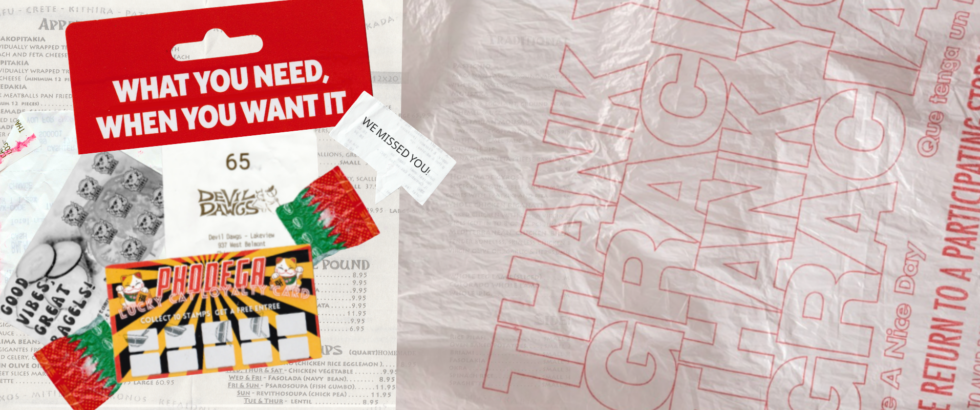
A few days later, rifling through my wallet, I passed a small red-and-gold card decorated with lucky cats and a rising sun. Across the top, in chunky yellow letters, it reads “Phodega.” On the back are ten little boxes. Collect ten stamps, get a free entree.
I have three.
Phodega is an Asian-American noodle and snack shop in Chicago’s West Town, a few blocks from a house where my partner and I stay when we’re house-sitting for family — a little borrowed-neighborhood life we slip into for a couple of weeks at a time, usually twice a year. Inside, a neon sign reading SEND NOODS hangs above a pyramid of Café Bustelo cans. Over the counter, another sign cheekily warns: “Don’t Try It. You Won’t Like It.” The menu includes salt-and-pepper chicken skins with sweet-and-sour sauce and something called the Viet Dip, a sandwich served with a little cup of pho jus.
The punch card is almost comically unsophisticated. It cannot send a push notification. It does not know where I live, what time I usually eat lunch or whether I have recently been searching for sandwiches. If I neglect it for six months, it will not announce that it misses me.
And yet it works.
Want more great food writing and recipes? Sign up for Salon’s free food newsletter, The Bite.
Every so often, while looking for a credit or business card, I flip past it and think about Phodega Fries — ribeye, cilantro, onion, jalapeños and gravy piled over seasoned fries — and decide that perhaps it is time to acquire punch number four.
During those house-sitting stretches in the neighborhood, I started feeling, embarrassingly quickly, like something of a local. The third time I walked into Phodega in about two weeks, the woman behind the counter looked up, smiled broadly and asked whether I wanted what I’d gotten last time (the Viet Dip) or wanted to try something new.
Something new, I decided. I ordered the Hainan-style chicken rice.
This is, of course, exactly the sort of interaction that restaurant apps are forever attempting to imitate. They remember what we ordered. They remind us of our favorites. They greet us by name. They offer suggestions based on what we liked last time. But there was a crucial difference in that question from behind the counter: The same thing, or something new?
She remembered me without assuming that remembering me meant she knew what I wanted.
“We know your favorites”
I like being known in restaurants. I like going to the coffee shop where the barista remembers that I take my mint tea iced and unsweetened, and I remember that she has a puppet showcase coming up. I like the brunch place where a waiter knows I want blackberry jam with my Texas toast, and I know what his nieces have been reading lately. This kind of familiarity is one of the pleasures of becoming a regular somewhere: over time, without really deciding to, two people accumulate small pieces of information about each other.
The information goes both ways.
This, increasingly, is what feels strange about the language of food apps. They borrow the vocabulary of that relationship — we remember you; we know your favorites; we missed you — while removing the reciprocal part entirely. They may know precisely what I ordered at 9:43 p.m. on a Wednesday six months ago, but there is nobody on the other side for me to know in return.
And increasingly, there is an app for almost every place we eat. The fast-food standards have them, of course, but so do regional chains and neighborhood coffee shops: download this, order ahead, skip the line, collect points, save your usual. The bargain is convenience, and often it genuinely is convenient. But increasingly, buying a sandwich or a cup of coffee also means initiating an ongoing relationship — one in which the restaurant gets a permanent little doorway into your attention long after the transaction is over.
And lately, simply remembering what we bought is beginning to look almost quaint. The next frontier is not merely knowing what we have wanted before.
It is trying to decide what we are going to want next.
A few weeks ago, I opened GoPuff, a grocery delivery app, and noticed a button I hadn’t seen before: a black square with a blue-and-white “go” glowing in the center. I tapped it.
CURATED FOR YOU.
“Pulled your late-night comfort picks,” it explained, “the usual craving fix when you order after dark.”
The screen looked almost like a cheerful kitchen-table flat-lay: products arranged over a wood-grain background, hovering around a GoPuff bag as though someone had just come home and emptied the evening’s provisions onto the table. Some were plausible: grape Uncrustables, chocolate-covered raspberries. Then came paper towels, Method cleaner, dish soap, lime sparkling water and grapefruit-scented antibacterial wipes. Apparently my 2 a.m. self is part snack-seeking raccoon, part conscientious housekeeper.
Only then did I realize this wasn’t simply a recommendation screen. GoPuff had already put every item in my cart.
The price wasn’t displayed there. I had to navigate into the cart to discover the total: $50.30.
There was an “undo auto-add” option, but it appeared in smaller, considerably less enthusiastic type. The phrase itself got me. Auto-add. The assumption was built into the feature: We have already begun shopping for you. Correct us if necessary.
I removed everything one item at a time and haven’t used the app since. I was already in the process of thinning out my reliance on delivery apps, mostly because I’ve been thinking more carefully about the cost of all that frictionless convenience — not only in money, but in how quickly every minor want can become immediately fulfillable. I haven’t sworn off delivery, nor do I particularly want to. But GoPuff made another part of the bargain newly explicit: convenience was beginning to include having my wants interpreted for me.
If a company is going to behave like a friend, eventually the friend can become presumptuous.
That is the distinction I keep returning to.
I don’t mind recommendations. Sometimes I want help deciding. But “Would you like help?” is different from “We went ahead and decided.”
Perhaps I’m protective of that difference because, of course, companies have always tried to stoke and steer desire. What feels different now is how easily they can follow us while doing it, often in the faux-friendly voice of someone who knows us — popping up on the little televisions in the backs of taxi cabs, slipping into the social media feeds in our pockets, texting us that they miss us while we’re trying to take a nap. The sales pitch has become harder to escape precisely as it has become more intimate.
Appetite, though, is not always something we know in advance.
Recently, I went to the grocery store intending, more or less, to buy ingredients for spaghetti with a weeknight Bolognese. I had already picked up a white onion, although an onion is hardly a binding commitment; so many good dinners begin that way.
The sales pitch has become harder to escape precisely as it has become more intimate.
Then I saw a jar of sun-dried tomatoes I’d never noticed before, packed with dark, jewel-like fruit. A pile of particularly good-looking spinach caught my eye. One decision tugged at another, and by the time I checked out, dinner had become rigatoni with chicken, spinach and sun-dried tomato sauce.
This is not an earth-shattering example of the mysterious contours of human desire. Dinner simply changed. But food is full of these tiny departures: the dish ordered on a whim that becomes the thing you return for; the ingredient you taste for the first time and immediately begin imagining in everything; the afternoon when what sounded good yesterday suddenly sounds terrible today.
That is one of the pleasures of appetite. Sometimes you enter the store with an idea and let yourself be talked out of it by a vegetable. Sometimes you only discover what you want as you go.
Food companies are increasingly interested in that interval, too. As Cris Tolomia reported this week at Quartz, Nestlé is piloting AI-powered simulations designed to model how shoppers might react to new products before they launch, while a separate AI system scans social media for shifts in what consumers want. The tools are part of a broader push into AI-assisted product development, including Nestlé’s work on foods for people taking GLP-1 drugs.
That is obviously several steps removed from GoPuff loading antibacterial wipes into my late-night cart. Nestlé is looking for signals across markets, not deciding what one particular shopper should eat at 2 a.m. But both illustrate how valuable it has become for food companies to arrive earlier — to understand appetite not merely after a preference has been expressed, but while it is still taking shape.
Which makes the moment when we still have to ask ourselves what sounds good feel increasingly precious: a little unoptimized space before something has been recommended, queued or dropped into a cart for us.
Maybe that is why I like that little Phodega card so much. It will wait in my wallet until I decide I want another sandwich, and when I do, someone will punch another square.
It rewards the wanting after it happens. It leaves the wanting itself to me.
Read more
from Ashlie D. Stevens
Source link