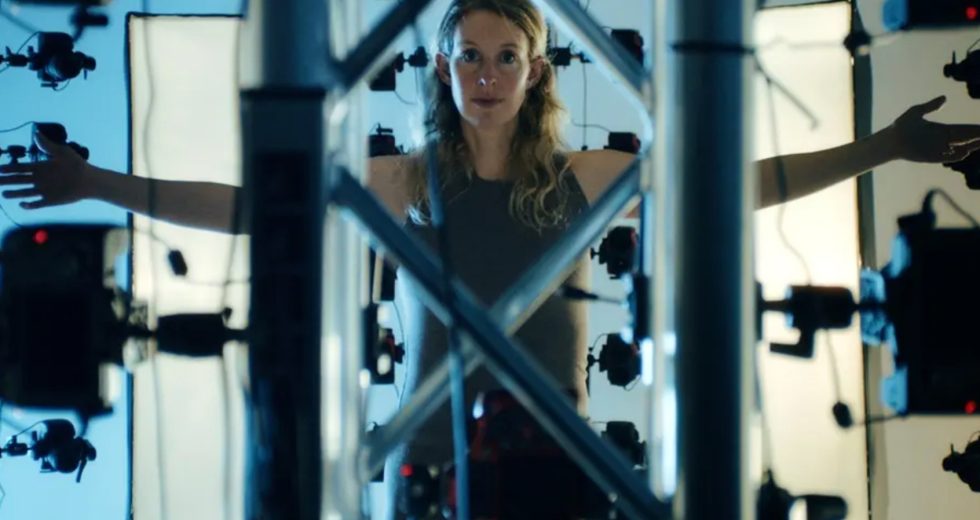
In the first episode of his hit HBO series, “The Rehearsal” — a show about evaluating the outcomes of hypothetical real-life situations — comedian Nathan Fielder admits, “I’ve been told my personality can make some people uncomfortable, so I have to work to offset that.” For Fielder, who is equal parts lovably strange and dryly hilarious, offsetting other people’s discomfort can be a sizable task. It’s not easy to go through life in a double consciousness, hyperaware that one’s behavior might offend or unease. “Humor is my go-to instinct,” Fielder says about trying to reassure others. “But every joke is a gamble.”
Consider, then, the overlap between Fielder and someone like Elizabeth Holmes, founder of the bogus blood-testing company Theranos, who was convicted of swindling hundreds of millions of dollars from investors with her purportedly revolutionary blood-analysis device. Even before her downfall, Holmes drew the media’s attention with her wide, unblinking eyes, bold red lip, deep voice and stilted speech — all of which became parody-ready upon her indictment. But all the more perplexing was Holmes’ reticence to admit guilt when caught with hands as red as her lipstick, talking herself in circles in pursuit of her truth. Her statements always seemed misaligned with the evidence, as if she were so convinced of her company’s virtue that she didn’t care about the eerie dissonance between her reality and the world’s. If Holmes was indeed playing a character she made up, as many people speculated, she was a skilled method actor.
As Fielder gains steady footing on the margin dividing observation and manipulation, aiming the camera at either side, he uncovers something deeply, cosmically sad: Holmes can’t seem to tell the difference between the two.
Sitting just inches apart around a San Diego beach rental’s dinner table in Fielder and co-director Lance Oppenheim’s magnificent new documentary, “You Can See Everything,” Fielder and Holmes look decidedly comfortable with one another. They share an ease and rapport neither has readily exhibited on camera before — certainly not around virtual strangers. But while they may not share many overt similarities, the strange duo align in their mutual slipperiness.
Before them lie components of Theranos’ blood-analyzer, which Holmes hopes to turn into a new product after her 11-year prison sentence, set to begin 34 days after filming begins. Trying to explain the device, and how her claims of its efficacy were misread by investors and the public, Holmes once again can’t translate her thoughts into words that make sense to Fielder. Instinctually, Fielder makes a joke. “Isn’t it funny that I hosted a show about business scams, and now you’re in trouble for a business scam?” Holmes remarks that she hadn’t thought about it until now, and the tension lifts as her frustration dissipates. Despite his well-intentioned wisecrack — or perhaps because of it — Holmes can relate to her new associate. Somehow, Fielder can see her.
But which version of her Fielder — and, by extension, the audience — sees, and which version is the truest, remains up for debate. The title “You Can See Everything,” taken from a text Holmes sent to Fielder during production, is an obvious red herring. This documentary is about a woman notorious for her deception. We, of course, can’t really see anything.
And yet, it’s all on display. Fielder, Oppenheim, and the viewer share the task of putting those pieces together legibly, to tell Holmes’ story in a way that hasn’t already been done for her by the media, Hulu’s limited series “The Dropout,” and Holmes’ muddled observations. As the film plays out, its three-hour runtime gliding by in a flash, it becomes painfully clear that this is what Elizabeth Holmes has wanted all along: for someone to tell her story in a way she can’t — not because she doesn’t want to, but because she herself is unclear about what that story is. Breaking through Holmes’ tight circle of dubious companions, Fielder pulls at every thread he can, attempting to unravel a greater truth from life’s gnarled yarn. As he gains steady footing on the margin dividing observation and manipulation, aiming the camera at either side, Fielder uncovers something deeply, cosmically sad: Holmes can’t seem to tell the difference between the two.
That does not, however, mean she doesn’t want to try. Holmes is intent on letting the cameras see as much of her life as possible, not only to prove the innocence she’s maintained all along, but to show that she has nothing to hide. She understands that the world sees her a certain way, a way she doesn’t understand — or, in the case of the infamous photo of her holding a vial of blood between two fingers, outright refutes — but that people’s perception is entirely out of her control. Maybe emerging from hiding for the first time in seven years with a full-scale documentary team isn’t such a bad idea. Five weeks out from a decade in prison, what’s the worst they could uncover?
“You Can See Everything” isn’t so much about big, jaw-dropping revelations as it is about the people behind them, and the assortment of personality and/or neurodevelopmental disorders fueling their actions. Holmes raves about her husband, San Diego hotel-chain heir William Evans, whose ego takes up most of the space in their beachside rental. When Fielder asks how he and Holmes met, Evans relays murky details of a 2017 party where the two spoke for an hour before he realized who Holmes was, even though he’d toured the former Theranos building the day before.
Later, during a visit from Holmes’ parents, Fielder asks Holmes’ father, Christian, about her former lover and Theranos business partner, Sunny Balwani. Evans immediately interjects, trying to halt and redirect the conversation. Persisting, Fielder asks Christian to pinpoint a turning point in his daughter’s life. “That’s an easy one,” Christian says, confessing that the turning point came when Holmes was sexually assaulted at 19, a crossroads that Holmes admits had a hand in her dropping out of Stanford and starting Theranos.
Want more from culture than just the latest trend? The Swell highlights art made to last.
Sign up here
When Evans derails the conversation again, a new question pops up — an occurrence in this film as natural and frequent as breathing. Is Holmes’ husband trying to maneuver the situation because he cares for his wife, or because his behavioral patterns mirror those of Balwani and Holmes’ assailant? All three men directly impacted Holmes at vulnerable points in her life, and from the film’s outset, it’s clear Evans savors controlling the narrative, whether through Holmes’ life’s work or simply the way she whisks eggs for scrambling. What’s constantly baffling is how much affection Holmes has for her repugnant husband, no matter how much he twists stories or alienates the film crew. One could say the two share a talent for deception, but it always feels more complex and tricky than that, as if it would be too easy to say that Holmes and Evans get along because they’re both hucksters, skilled in fabrication. They both get something out of this relationship. Whether it’s love is anyone’s guess.
What’s brutally, painfully clear, beyond a shadow of a doubt, is that Holmes has not yet learned how to use her own voice. She knows how to speak, dictate orders and ideas. (And, obviously, how to fool powerful people.) But Holmes doesn’t grasp where her ideas end, and someone else’s influence begins. She personifies a complete lack of identity, so irrevocably tied to her inventions, physical or otherwise, that, compared to Fielder — whose work is marked by his own keen self-awareness — she looks like the diametrical opposite. Holmes is the tragedy to his comedy. Naturally, the two are intrinsically connected.
Many things about Elizabeth Holmes aren’t certain. But what’s irrefutable is that she knows how lonely it is not to be able to communicate the world inside her head, and how painful it is not to understand others the same way. It’s no wonder that, when she meets someone who can bridge that gap, she wants to make a monument of it.
All of the questions about who’s running Holmes’ show take new, thorny form as the film blossoms in its latter half — the portion that, thanks to a surprise guest, makes the movie one of the most startling and memorable exercises in metafiction ever concocted. But the film’s most heartbreaking and pivotal scene comes in its first third, before Holmes surrenders, when Fielder gathers her and Evans on the couch to show them Abbott and Costello’s famous “Who’s on First?” act.
Fielder tells Holmes that he was reminded of the bit the day before, when Holmes tried to describe the science and intention of Theranos in front of its deconstructed prototype. Holmes has never seen the routine, and gives it a few chuckles. But when Fielder asks her to explain the joke — that “Who” is the name of the baseball player on first base, yet sounds like a question, confusing the two men — and why it’s funny, she can’t. As Fielder clarifies the punchline, Holmes breaks down in tears across from him, frustrated that she can’t understand.
In this moment, Fielder conjures a world of empathy for his subject, again posing questions about what gets lost between two people who believe they’re being perfectly clear, yet aren’t making sense to one another. Many things about Elizabeth Holmes aren’t certain. But what’s irrefutable is that she knows how lonely it is not to be able to communicate the world inside her head, and how painful it is not to understand others the same way. It’s no wonder that, when she meets someone who can bridge that gap, she wants to make a monument of it — be it a business, a marriage, a film or a profession of love.
Though the questions persist: Is this all part of Holmes’ master plan? Is she letting the cameras in to dupe us, to make us feel sorry for someone whose actions caused real harm? Maybe. Those seeking clear answers will leave with nothing more than new questions, but that’s the glorious part of “You Can See Everything.” In an era when documentaries are made for everything and nothing, it’s critical to remember that searching for reason in something as immense as the human condition is a fool’s errand.
Fielder might be fascinated by motive and rationale, but he’s primarily interested in circumstance, and he understands Holmes’ circumstances perfectly. His film is a self-reflexive study of the inability to act as people expect — of masking and deception. How much of life is a performance? Can anyone truly be themselves when society’s bylaws not only dictate proper human behavior but also how successful anyone can be in something as complicated and unknowable as life itself? In seeking the truth, all one finds is more differences, more judgment. Sure, we can see everything. But whether we really should is another question entirely.
Read more
about Elizabeth Holmes’ mythmaking
Source link