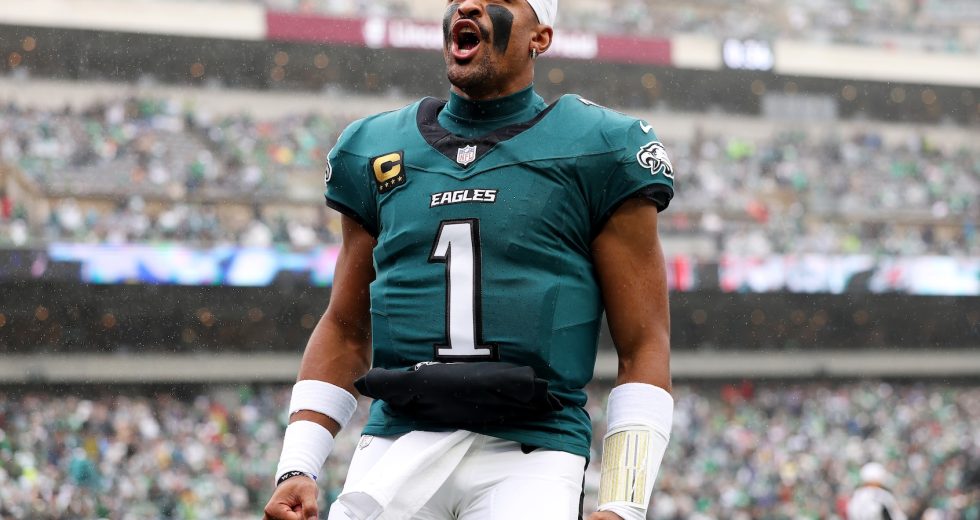
Jalen Hurts, the Philadelphia Eagles’ starting quarterback, is out for the season to recover from a deep vein blood clot, found after arriving in London for the game in which Hurts played between the Eagles and the Jacksonville Jaguars.
A Philadelphia sports columnist argued a few years ago that if Brock Purdy, the San Francisco 49ers quarterback, were the Eagles quarterback, he “would be a god in Philadelphia,” because of his underdog story. Hurts is an underdog as well. The difference is that Hurts is Black and Purdy is white. But like Michael Jordan’s flu game in the 1997 NBA Finals, where he played sick, playing a football game after being diagnosed with a blood clot and getting little to no rest seems godlike enough to cancel that columnist’s point.
However, questions have largely landed on Hurts. Questions about his leadership, aptitude, and attitude as the Philadelphia Eagles’ quarterback, and now about the severity of a blood clot and his commitment to the season amid roster challenges. The most egregious came from Michael Robinson of the NFL Network, who said that, in relation to Hurts’ current injury, Hurts seemed to be saying, “If everybody’s hurt, then I’m hurt too.”
But Hurts has a blood clot. Initially, it was diagnosed as a superficial vein clot, and now it is a series of deep vein clots that have since traveled to Hurts’ lungs. He’ll miss the rest of the season while he receives treatment but is expected to fully recover according to his agent Nicole Lynn. Hurts didn’t make his condition up. It wasn’t a cop-out for a season that seems to have gone down the drain. It’s the truth. Sadly, Hurts hasn’t been given the benefit of the doubt.
Hurts is perhaps one of the most disrespected players in the NFL as, in commissioner Roger Goodell’s words, a “face of the league.” National media pundits, Philadelphia media pundits, and even some Philadelphia Eagles fans disrespect him. Of course, Hurts has a cheering section, but their voices are often drowned out by the chorus and echoes of criticism. The narrative was that the 2026 season was make-or-break for Hurts, after a season when some were all too eager to offer “evidence” of Hurts’ share of the team’s offensive woes.
However, that same make-or-break standard hasn’t been applied to many of Hurts’ peers, even those who have accomplished less than Hurts. And while a contingent of Eagles fans wants Eagles head coach Nick Sirianni fired, it’s not a make-or-break season for him. Even after hiring his friend as offensive coordinator, who was clearly incompetent, or after showing himself to be inept as an offensive mind.
So what about Hurts engenders so much criticism and makes him such a polarizing figure? Last month, ESPN pundit Dan Orlovsky said Los Angeles Chargers quarterback Justin Herbert (compared to Hurts) is “what it should look like.” What about Hurts doesn’t look like how a quarterback is supposed to look? I thought a quarterback should look like a Super Bowl MVP? A better question is: how would any ex-backup quarterback, paid to define what a good, great, or elite quarterback looks like, know what that quarterback actually looks like? I assume because they’re familiar with what it doesn’t look like, but I digress.
Start your day with essential news from Salon.
Sign up for our free morning newsletter, Crash Course.
It can’t be because he’s not a pocket passer, checked out of plays, or stoic and cryptic. It could be because women find him very attractive, making the manliest of men very insecure. Maybe it’s because some folks believed any part of the AJ Brown nonsense. But I suspect it is deeper than that. You probably won’t like the answer I am about to give, but you know what’s coming: Racism.
Racism has long been a part of the NFL’s history: long before Colin Kaepernick and Brian Flores; long before the league’s history of race-norming to prevent Black retirees from accessing concussion settlement claims. The racism goes as far back as 1933, when the league instituted a ban on Black players. Once allowed back in the league in 1946, a sorting process known as racial stacking was instituted due to the widespread belief that Black athletes weren’t smart enough to play quarterback.
The city of Philadelphia doesn’t get a pass on its racist history simply because more Black quarterbacks have started games than white quarterbacks for the Eagles over the last 40 years. Randall Cunningham, Donovan McNabb, and Michael Vick have all faced their share of racism disguised as criticism at the position. It’s Hurts’ turn to receive some of that same criticism, I suppose, but what fuels it is especially disgusting.
“They play a game, but they aren’t here to play games.”
Hurts isn’t an Allen Iverson-like figure whose tattoos, cornrows, and “posse” make him easily labeled as a “thug.” He isn’t a Joel Embiid-like figure whose struggles on the court and history of missed games make him easily labeled as “lazy.” He’s not a womanizer, he’s not violent, and he’s not unintelligent. He’s none of the easily identifiable tropes placed upon Black people.
Hurts is, however, unapologetically Black.
The unapologetically Black person wears their Blackness every day, regardless of who is offended or discomforted by it. They aren’t phased by narratives designed to devalue their accolades and their acumen. They embrace themselves and their culture. They’ll speak, behave, relate, and respond in ways unfamiliar to the mainstream, soliciting criticism from a lens filtered by whiteness, labeling anything but white as a failure to meet a standard of posture and decorum. In short, they’re not here to make white people comfortable.
Hurts is proud to be a Black man. He makes crawfish, listens to Frankie Beverly and Maze, and doesn’t ingratiate himself with the sports media machine, largely a white institutional space. He doesn’t yell at officials in a display of passion like Tom Brady, only to be treated like Dez Bryant. He doesn’t respond to media questions the way some journalists believe he should; he doesn’t “scratch where [he doesn’t] itch, and laugh when [he wasn’t] tickled.” He isn’t happy to be in front of the media, like so many more “appreciative” athletes posit themselves to be. As Hurts has said himself, he had a purpose before everyone had an opinion. That goes for white and Black sports media talking-heads alike, whether Emmanuel Acho, Doug Gottlieb, Linda Cohn, or Stephen A. Smith.
The unapologetically Black person may be the most threatening entity to the current social order of the sports industry. They’re threatening because they’re not consumed by the traditional effort to posit themselves as “respectable” in an industry predicated on Black athletes “knowing their place.” They’re not consumed by a desire to appear thankful for the privilege to make money from playing sports. They play a game, but they aren’t here to play games.
However, we live in a culture of hot-take artists who want the immediacy of fame rather than building a record of credibility and significance. The talking heads are all too willing to critique Hurts and others like Kyrie Irving and Angel Reese, only to eat crow each time they accomplish something on the field or on the court. For example, Angel Reese’s critics are eating crow after she became only the 3rd player in WNBA history to post 30 points and at least 15 rebounds in a WNBA Finals game. Reese had 30 points and 16 rebounds.
Nevertheless, racistly-coded commentary disguised as asinine takes will continue, because those takes continue to fuel the careers of formerly respectable journalists while establishing new careers for former athletes whose trajectory mirrors that of their playing days, serviceable at best, but likely missing the mark. That commentary vis-à-vis Hurts is the only reason some of these folks are relevant. But when it comes to Hurts, the only relevant thing is that he played a football game with a condition that became life-threatening, and the only critique worth levying and entertaining is that, against the Philadelphia Eagles, there was negligence in their handling of Hurts’ health. As for Hurts’ haters, his performance against the Jaguars in London under the circumstances we now know will be praised. It has already started.
I guess all it took was almost dying … godlike behavior. But Black people working to death in exchange for white acceptance is a rite of passage imposed on Black folk. It’s the American way.
Source link