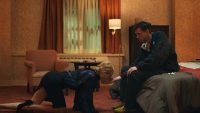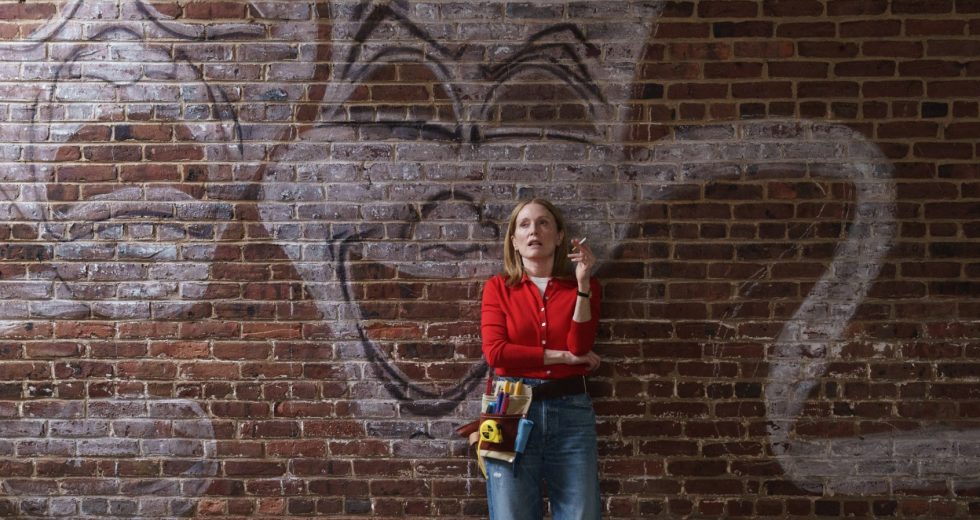
It’s audition day at New Jersey’s Brook Arts Center, and everyone is a bundle of nerves. Actors dot the lobby, doing vocal warm-ups between mini panic attacks and greeting old friends from past shows. This year’s production is “Nosy Neighbors,” a forgotten musical about a New York apartment building and its kooky tenants, including its superintendent, Miss Danielle — a dreamer who, despite repairing clogged toilets and collecting rent for a living, hasn’t let the city spit her out. The role is a bit part, but features a showstopping centerpiece number, the kind of song musical theater performers eat, sleep and breathe. But for mousy housewife Mona Friedman (Julianne Moore), the size of the part or the strength of the song don’t matter. Miss Danielle seems like the right choice to audition for because the role is age-appropriate, and Mona wants to be included however she can be.
And though this might be New Jersey community theater, the standards are just as high as on Broadway. Renowned local director Jerry Blankenbuehler (Paul Giamatti) demands perfection; anything less than excellence won’t touch his stage. Mona, of course, has no way of knowing this. She’s an interloper among established thespians, a woman in her late 50s who has only just begun listening to the little voice inside her, the one begging her to step outside her comfort zone. She’s up against seasoned actors and singers who know what they’re doing, whose every step, gesture and note resonates effortlessly. Yet, somehow, that doesn’t stop her. Despite her nerves, she stands in the spotlight and sings Miss Danielle’s big number. It doesn’t matter how timidly the words might’ve come out; what’s important is that Mona did it.
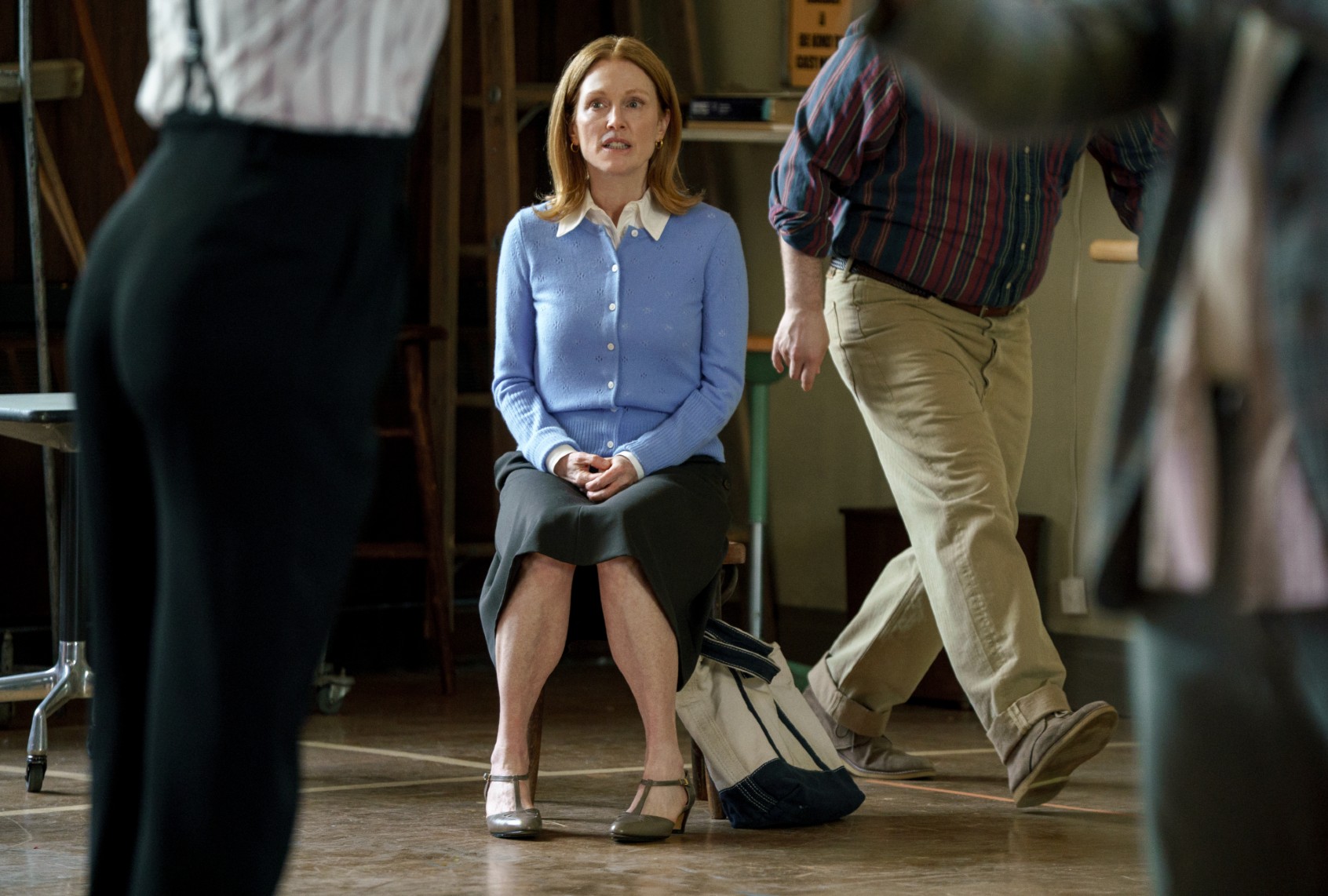
(A24) Julianne Moore in “The Debut”
Mona transforms before our eyes from a diffident mother of two in an unhappy marriage into the star she always could be, though not without a few bumps in the road. It’s these obstacles that make Eisenberg’s film feel all the more realistic, accurately representing how much work it takes to find oneself, an arduous process that must be experienced over and over in different ways.
This is the brilliant way writer-director Jesse Eisenberg thrusts us into his third — and best — feature, “The Debut,” screening at this year’s New York Film Festival and premiering in theaters December 11. We meet Mona in media res, nervously tapping her shoes on the carpeted lobby floor and fretting over her audition. But instead of the traditional cutthroat audition setting, where every actor silently sizes up the competition, the Brook Arts Center fosters a warm environment. Fellow actors Stef (Halle Bailey) and Trish (Bonnie Milligan) assure Mona she’ll be wonderful. And though Mona’s audition might be far from it, that little spark of community and care is all she needs to feel like she’s right where she should be.
Want more from culture than just the latest trend? The Swell highlights art made to last.
Sign up here
Finding this sense of contentment isn’t easy. Some go their whole lives searching for it, aching to find where they belong, or what gives them purpose. The longing is what makes life beautiful and also impossible. We’re so often told in childhood that we can be anything and anyone we want to be, dazzled by illustrations of astronauts smiling through their helmets while floating in space, or ballerinas gracefully twirling while dancing “The Nutcracker.” But just as often, these turn out to be children’s fantasies — wide-eyed dreams of imaginary futures, tempered by real life. Bills must be paid. Kids have to eat. We have to survive. And in the pursuit of survival, there’s rarely time for side quests.
That’s precisely why “The Debut” is such a brilliant revelation. There’s no shortage of cinematic depictions of people getting their groove back, but seldom is the search for the self portrayed with as much tender empathy as Eisenberg and Moore have for Mona — an instant all-timer in Moore’s stacked repertoire. Over the film’s blissful 105 minutes, in which Moore appears in every scene, Mona transforms before our eyes from a diffident mother of two in an unhappy marriage into the star she always could be, though not without a few bumps in the road. It’s these obstacles that make Eisenberg’s film feel all the more realistic, accurately representing how much work it takes to find oneself, an arduous process that must be experienced over and over in different ways. As Mona discovers, the stumbles are as important as the triumphs. There is no greatness without embarrassment.
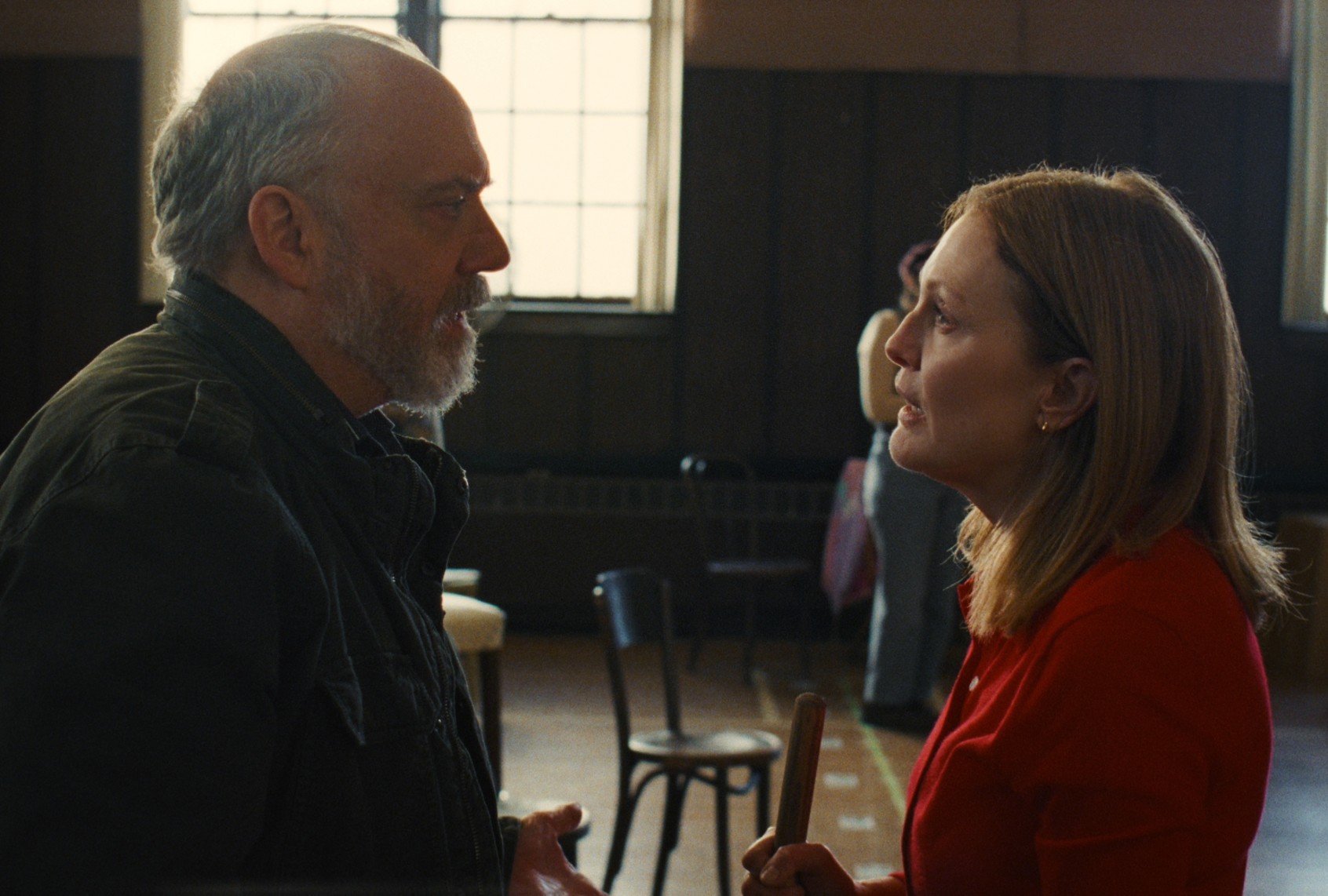
(A24) Paul Giamatti and Julianne Moore in “The Debut”
But to be embarrassed, one must first get the chance to be embarrassed. The role of Miss Danielle is Mona’s to lose, and lose she does to local legend Serena Cherry (a wonderful cameo by Bernadette Peters), who gives Mona’s big song all of the polished oomph of the Great White Way. But competition isn’t any concern of Mona’s. She’s more interested in what simply auditioning made her feel, how she came alive, if only for a brief few moments until Jerry cut her off. On a double date with her husband and their best friends, Mona, beaming, tells the group that she’s auditioned for “a musical show.” Her inadvertent gaffes with industry terminology might make her seem silly and out of her depth. But they also indicate an eagerness to learn, a will that makes Mona’s eventual callback after Serena Cherry drops out of the show seem almost like manifestation.
And, really, that’s all achieving anything in this life is: manifestation. While the word has been co-opted and corrupted by vision-board romantics and TikTok gurus, it’s still the key to making what we want happen. Manifestation doesn’t mean something we want pops out of thin air just because we think about it; it means hard work and relentless effort. And if struggling is how Mona will mold herself for the theater — stretching and shaping her performance into something worthy of the greater New Jersey area’s most prolific stage — so be it.
It takes immense skill for a great actor to convincingly play a novice performer. And because Moore is so talented — so uniquely proficient at finding the human depth at the core of all her characters — she can make Mona unforgettable. Here, Moore shows reverence not only for her own craft, but for all the hopeful idealists who pine to know what it feels like to lose yourself in someone, or something, else. As Mona goes deeper into Miss Danielle, turning a minor role into something far bigger and more unwieldy than anything she or Jerry prepared for, Moore reminds us why we lie awake at night, convincing ourselves there might be more to life. We don’t just search for something that fulfills us because we want to know what it feels like to be happy in our work or hobbies; we do it to make sense out of a nonsensical life, to understand what being a human is all about.
To say I can relate would be an understatement. I rarely find myself both crying with laughter and crying through my laughter in the span of the same film. It moved me deeply to be tossed headlong into Mona’s life, to sit beside someone who, one day, decided that she wanted something else for herself. I saw reflections and heard echoes of all of the reservations I had about becoming a writer, telling myself that I’d never be able to conjure the commitment it takes to write consistently, afraid that everyone else had sharper, smarter worldviews than mine — that they could see things I’d never be able to. I’d convinced myself that it would take too much time to start over, and that it wasn’t worth trying.
Moore reminds us why we lie awake at night, convincing ourselves there might be more to life. We don’t just search for something that fulfills us because we want to know what it feels like to be happy in our work or hobbies; we do it to make sense out of a nonsensical life, to understand what being a human is all about.
But, like Mona and her fond memories of childhood church choir, I couldn’t let the urge go. It wasn’t enough to simply watch films; I needed an outlet for all the ways they made me feel and all the ideas they inspired. My life didn’t feel complete just watching other people’s art. I wanted to make my own, too. And, again, like Mona, accepting that dream as a potential reality can shift your self-perception entirely. I’m not the same person I was when I first started this, and I often feel like I don’t recognize the person who first put finger to keyboard. Getting here now — typing away while I sniffle with a cold, a life I wouldn’t change for the world — required carefully deflating a rapidly overblown ego.
There’s a tendency to think that, because one has had any success at all, be it a musical callback or a greenlit freelance piece or a short story selected for publication, that they know best. But that’s never the case, at least not in the arts. And as Eisenberg continues to remind us that this is not Mona’s musical — that everyone in the cast and crew is just as important as she is — “The Debut” starts to sing even more beautifully than it already had.
But “The Debut” is not only for those in, or interested in, the arts. It’s a film for anyone who has put aside their desires and told themselves it’s too late or too scary to try something new. Be it gardening, ceramics, hang gliding, mountain climbing, swimming, competitive hot dog eating (well . . . consult your doctor), photography, skeet shooting, upholstery, or even just journaling, trying anything and everything to be closer to your happiest self is worthwhile. You may crash and burn, sure. But you might also come to understand your reason for living. Either result will paint a fuller picture, widening the spotlight little by little, until everything begins to glow.
Read more
about unforgettable Julianne Moore performances
Source link