Director Matt Johnson’s latest feature, “Tony” — a biopic following a young Anthony Bourdain (Dominic Sessa) through his first kitchen experience, slinging cheap fish in a Provincetown greasy spoon — exists inside a quote. The film opens with a pull from Bourdain’s beloved pseudo-memoir, “Kitchen Confidential,” in which Bourdain reminisces about his 19-year-old self, trolling around Cape Cod trying to impress a girl and become a writer, with zero experience doing either. “I was — to be frank — a spoiled, miserable, narcissistic, self-destructive and thoughtless young lout, and badly in need of a good ass-kicking,” Bourdain writes early in the book.
From the jump, it’s hard to shake the feeling that “Tony” is mistakenly aligning itself with the public’s idea of Bourdain rather than the man’s reality. When I think of Anthony Bourdain, I think of two people. The first is the enigmatic yet ultimately unknowable chef, whose charm and good nature sometimes dulled a cloud of unmistakable darkness to the eyes of the public; the second is the idealistic version of Bourdain, who exists in half-remembered citations and GIFs of his many travel shows removed from their context — rosy, nostalgic tributes to an image, rather than a person.
Regrettably, “Tony” operates in the latter state: all sentiment and little practical truth, different from the ways Bourdain’s effusive, colorful work and writing make people feel when they really dive into it. It’s part biopic, part coming-of-age story and all gung-ho idealism, battered and fried until golden and palatable, before being spritzed with a fresh splash of lemon, providing the film a brief, compelling tartness that fades all too quickly. Like a lobster roll made with imitation crab meat — or a guy who lists Bourdain as his biggest inspiration in a prompt on his Hinge profile — “Tony” is economical and satiating, but far less satisfying than the real thing.
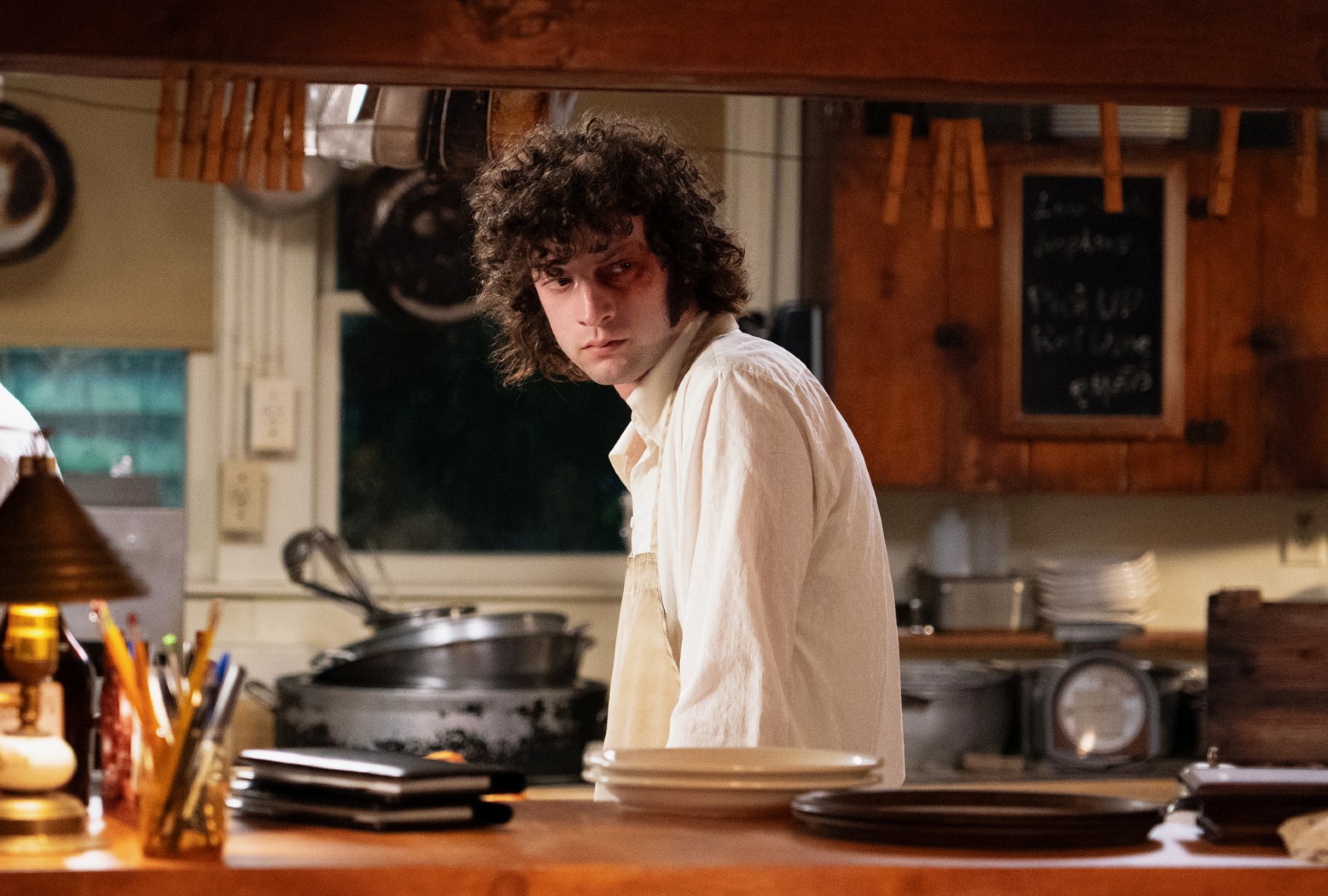
(Seacia Pavao/A24) Dominic Sessa in “Tony”
Bourdain gave fellow outsiders an insider’s view of the kitchen. He made people fall in love with food, its rituals and its culture. And though “Tony” doesn’t entirely lack that heady romanticization, its choice to amplify its introductory quote — making Bourdain an even more insufferable lout for dramatic effect — feels antithetical to Bourdain’s raw candor.
What’s more, the film is bizarrely undercooked when it comes to Bourdain’s experiences in the kitchen. To be fair, Johnson has his work cut out for him. “Tony” is adapted from only the first 50 pages or so of “Kitchen Confidential,” meaning Johnson and his co-writer Matthew Miller (working from a screenplay originally written by Todd Bartels and Lou Howe) essentially had to flesh out a pitch draft’s worth of detail into a feature-length film. And for those who like their biopic by-the-numbers, the finished product is a perfectly serviceable entry into the canon.
But I get the sense that, in comparing Bourdain’s writing to the film, true die-hards will long for his quippy, evocative storytelling that’s absent from “Tony.” Bourdain gave fellow outsiders an insider’s view of the kitchen. He made people fall in love with food, its rituals and its culture. And though “Tony” doesn’t entirely lack that heady romanticization, its choice to amplify its introductory quote — making Bourdain an even more insufferable lout for dramatic effect — feels antithetical to Bourdain’s raw candor.
Now, I’m not exactly a stickler for precise detail. All book adaptations, whether from novels or memoirs, could stand to embellish the facts here and there, or go ahead and reinvent the wheel when possible. This irks literature purists. But cinema is a different medium, and as such, changes must be made. It did strike me as odd, however, that “Tony” is forged on a factual alteration that diverts Tony from the kitchen far too often — the movie’s cardinal sin.
After pitching a bogus novel to the Vassar English department in hopes of scoring a writing fellowship that will provide his summer with a sizeable goofing-off stipend, Tony’s sure he’s got the prize in the bag. At a college bar, he drunkenly peacocks for his high school crush and fellow Vassar student, Nancy (Emilia Jones). Tony tells her that he’s going to be a famous writer, before challenging her comprehension of a few five-dollar words. Repelled, Nancy replies that she will be happily spending her summer slinging pizzas in Provincetown.
Surprise, surprise: Tony doesn’t get the fellowship, and instead, flees his childhood home early in the morning to catch a bus and a ferry to Provincetown. With no money but plenty of blind devotion to Nancy — whose character, it’s worth mentioning, has subzero charm and nuance, making Tony’s staunch affection feel like a ruse to the viewer — Tony arrives hapless and hopeless. It turns out Nancy’s got a pizza-slinging beau, so Tony drowns his sorrows in fried fish and cheap beers at the ramshackle clam shack The Flagship. When he can’t pay for his meal, Tony’s tossed out by the head Chef (Antonio Banderas) and his flighty kitchen cohort, Sal (Leo Woodall). Long story short: Tony wants to stay and pursue Nancy, Chef lets Tony sleep on his hammock in exchange for washing dishes at the restaurant, and the film can never decide which narrative to give more time to.
Want more from culture than just the latest trend? The Swell highlights art made to last.
Sign up here
In “Kitchen Confidential,” Bourdain describes his decision to head to Provincetown as an impulse motivated less by romantic desire than by general apathy. “I went in with some friends on a summer share in Cape Cod. It was what my friends were doing, and that was enough for me,” he writes. A brief mention of a pizza-spinning girlfriend is tossed off immediately after, replaced by vivid stories about his first summer working at the real-life Flagship, given the pseudonym The Dreadnaught. Each member of the kitchen crew in Johnson’s film is as scraggly and unpredictable as Bourdain describes them in the book, teaching him as much about sex and drugs as they did broiling lobsters and frying up clams.
Johnson is so concerned with conforming to the auspicious, nostalgic idea of who Bourdain was that he makes his biopic far too safe. He reduces Bourdain to a zygote who simply needed enough nurturing to become his older, cooler self, when he could, instead, read between the lines to find what makes young Tony special.
Here, “Tony” is in its element as Johnson crafts the intimidating yet irresistible camaraderie of a kitchen, and all of the misfits who work inside it. But when Tony leaves for the day and is left to his own devices in Provincetown, the movie falls hard into all of the trite trappings of your average biopic. Tony and Sal get into all kinds of trouble, snorting coke and banging broads, but these things often happen in freewheeling montages with little consequence. It’s nearly impossible to get a sense of how Tony himself is actually feeling. Watching this version of him is akin to seeing Sessa bang his hands against the confines of that Bourdain quote, desperately trying to make something substantial out of this thin rendering of a very significant persona.
All of the men who idolize Bourdain for their imagined notions of who he was — who model themselves after the image of him sitting in a leather jacket and tiny sunglasses, with a pack of cigarettes on the table of a Parisian cafe — will love it. Under a clip of Bourdain sitting at this cafe, one person commented (before Bourdain’s death), “When I grow up I am going to be just like Anthony Bourdain.” That’s the perfect summation of the toothless film Johnson has crafted.
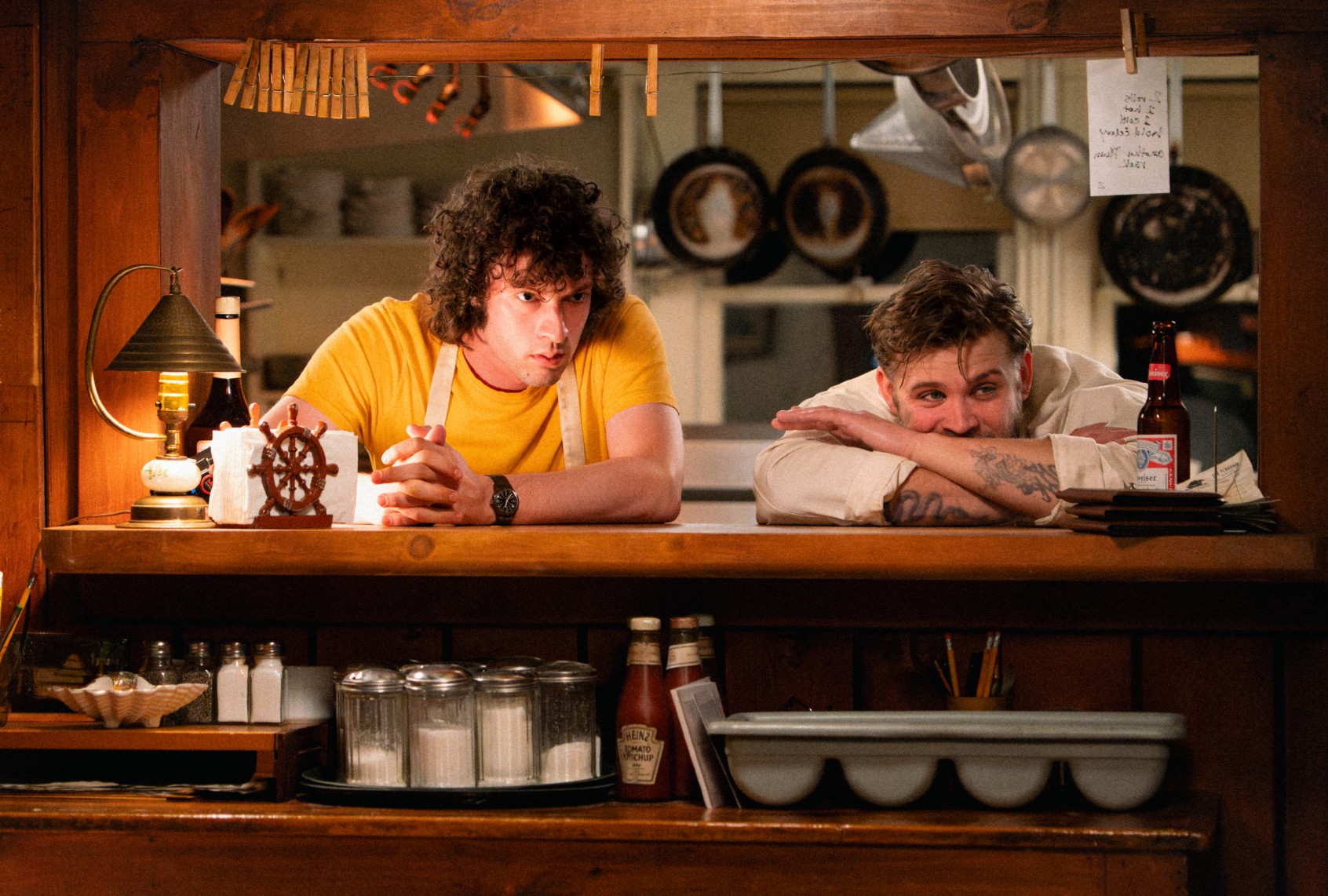
(Seacia Pavao/A24) Dominic Sessa and Leo Woodall in “Tony”
“Tony” tries to distance itself from the public’s quixotic version of Bourdain by making the younger depiction casually unbearable, the kind of person you wouldn’t enjoy working with — and especially not mentoring — in a kitchen. But these attempts largely come off as cloying, even silly. There’s one moment where Tony witnesses Sal score drugs before watching him shoot up on the boardwalk, as if to say, “We may not show it here, but Anthony Bourdain will later struggle with heroin use!” The dope is dopey, and it’s unfortunately only a foray into mushier territory. Banderas provides his mentor figure with a delightful vigor, but Johnson can’t quite figure out what to do with him, or how to make Chef feel like a real person. (How fitting we never learn his real name.) Even a few flowery sentences in “Kitchen Confidential” about lessons learned working at The Dreadnaught dwarf “Tony” in comparison. For a film about the origins of a foul-mouthed culinary renegade, beloved for his thoughtful musings on food and life, there’s bafflingly little interiority.
One could argue that’s Johnson’s point: Tony hadn’t yet become Anthony. Bourdain’s singular reflections could only come from a life well-lived and filled with mistakes. But that doesn’t mean that this version of Bourdain has to lack depth. Johnson is so concerned with conforming to the auspicious, nostalgic idea of who Bourdain was that he makes his biopic far too safe. He reduces Bourdain to a zygote who simply needed enough nurturing to become his older, cooler self, when he could, instead, read between the lines to find what makes young Tony special. Bourdain’s writing is far more tender and interested in other people than “Tony” ever is. And as intent on vivifying culture as Bourdain was, I think he’d watch this movie and feel that there’s an authenticity that is deeply missed. But we’ll never know that for sure. If “Tony” must open with a quote and confine Bourdain to his words, as he so often is posthumously, I’ll close with one that appears just a few sentences before it: “The less said about that part of my life, the better.”
Read more
about Anthony Bourdain’s big life
Source link