Throughout July, The Swell is celebrating the lasting cultural inspiration of animator Hayao Miyazaki and the legendary films he created with Studio Ghibli. As part of GKIDS’ annual Studio Ghibli Fest, which kicked off in June, you can enjoy theatrical re-releases of some of his most famous works.
Writing about culture means thinking about the world in magical terms. Or maybe it’s just me. I frequently struggle to find the right words to describe the elements weaving together the concrete and the conceptual, so I find it simpler to sum up all that as magic. All of us understand magic. Not everyone believes they have the capacity to express it, which is a shame. That’s why I think everybody needs a little “Kiki’s Delivery Service” in their lives.
Out of all of Miyazaki’s movies, “Kiki’s Delivery Service” may be his most timeless. It’s made for young hearts but also has a way of growing up with us, taking on new meaning when viewed at different life stages.
“Kiki’s Delivery Service” is not a Hayao Miyazaki original. He adapted it from Eiko Kadono’s 1985 children’s novel about a half-witch who strikes out on her own to fulfill a tradition established by her kind.
Kiki’s willingness to help others conveys a more important teaching about interdependence as an integral part of independence. Her efforts are acts of caring, moving others to do the same for her.
But “Kiki” holds several themes that recur in Miyazaki’s work. Our titular heroine is only 13 years old when her escapade begins – a little more mature than most of the director’s protagonists, but still innocent enough not to be jaded. Miyazaki’s tales also tend to immerse us in supernatural domains existing parallel to our own, as if reality masks more ethereal, life-affirming realms. Kiki, however, lives in a world that sees magic as part of the natural order, which plunges her into an existential crisis when she loses hers.
To young children, Kiki’s adventure is a simple fantasy about a kid who can fly on her mother’s broom and launches a business with the same enthusiasm that elementary schoolers radiate while running a lemonade stand.
Once Kiki leaves her village with her constant companion Jiji, a talking cat, she sails through the skies, albeit insecurely. She’s uncertain about her flight capabilities, and even less sure of herself when she encounters a more experienced and stuck-up witch who’s around her age, and who brushes her off instead of propping up her confidence.
Eventually Kiki ends up in a bustling seaside city that hasn’t had a witch in its midst in many years. After a rough start, including a run-in with an irritating policeman, she lands at the home of a baker, Osono, who gives her a place to stay in exchange for labor and her delivery services.
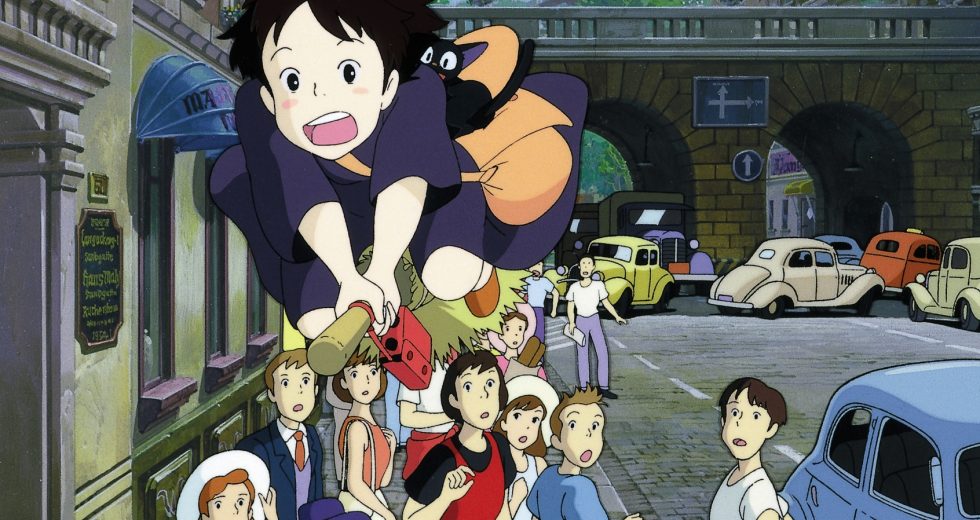
Since Kiki’s abilities allow her to defy gravity, she runs packages across town, avoiding auto traffic and pedestrian crowds. Her world looks and operates like ours, and that means there are no free lunches.
Osono’s kindness is part of the fantasy, in that she takes in a strange little girl and lets her live in her extra room without asking many questions. But even when Kiki botches a delivery by dropping a toy mid-air, sending it tumbling into a nearby forest, a bit of reciprocal effort solves the problem. Ursula, the artist who lives there, finds it broken and has Kiki scrub her floors in exchange for repairing it.
I’ve read a few interpretations of the narrative’s emphasis on labor exchange that assume these moments are meant to teach children that labor has value. Maybe. As I see it, Kiki’s willingness to help others conveys a more important teaching about interdependence as an integral part of independence. Her efforts are acts of caring, moving others to do the same for her.
While Kiki’s coming-of-age year as a witch requires her to live on her own, she’s never alone and can’t succeed without other people. That part of the story appeals to the restless adolescent versions of ourselves that can’t wait to find our place in the world.
The third act, however, hits hardest when you’ve lived long enough to lose your mojo and doubt yourself. Kiki meets a boy, Tombo, who is obsessed with flight and, specifically, Kiki’s marvelous ability to fly without the help of a machine. Initially she pushes him away, but Tombo is persistent. Eventually they become friends. And it’s to him that she admits, “Flying used to be fun until I started doing it for a living.”
Soon after that, Kiki wakes up to find her magic is absent. She’s expended so much of it on others that she has none left for herself. She can’t even understand Jiji anymore.
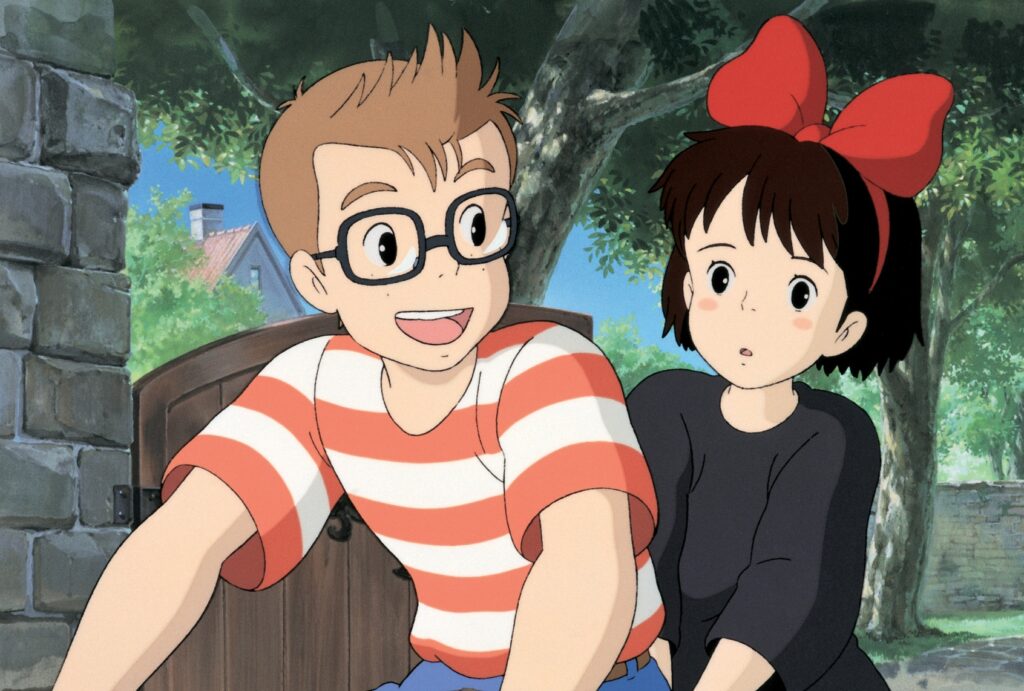
(1989 Eiko Kadono/Hayao Miyazaki/Studio Ghibli, N) A still from “Kiki’s Delivery Service.”
If every Miyazaki movie has a whiff of biographical relevance, one might see “Kiki’s Delivery Service” as his statement of creative purpose and motivation. Who can help a witch who’s lost her flight? A woman who lives alone in a house in the woods, of course – although she’s an artist, not a witch. Ursula’s advice to Kiki is the same as any career coach or mental health professional counseling someone through a crisis of confidence: Stop working so hard, take a walk and look at the world for a while.
“We each need to find our own inspiration, Kiki,” says Ursula. “Sometimes it’s not easy.”
Want more from culture than just the latest trend? The Swell highlights art made to last.
Sign up here
I can’t think of a person who makes a living from their talent that doesn’t feel that way at some point. We call it burnout. To Miyazaki, Kiki’s depletion is a sign that she’s leaving childhood behind. She regains her ability to fly but is never able to communicate with Jiji again. So maybe she doesn’t quite regain her magic but taps into a new version of it.
Magic is a five-letter word that does so much heavy lifting when it comes to describing the essence of what makes something special. Thinking of it that way makes life sweeter, too. Science can explain the world around us, but magic helps us appreciate the wonder in the atomic arrangement of nature, chance meetings with open-hearted souls and kindness without expectation of anything in return. “Kiki’s Delivery Service” has been telling us that since the very first time we saw it, and in new ways with each repeat viewing.
“Kiki’s Delivery Service” is streaming on HBO Max.
Read more
from Salon’s Culture newsletter, The Swell
Source link