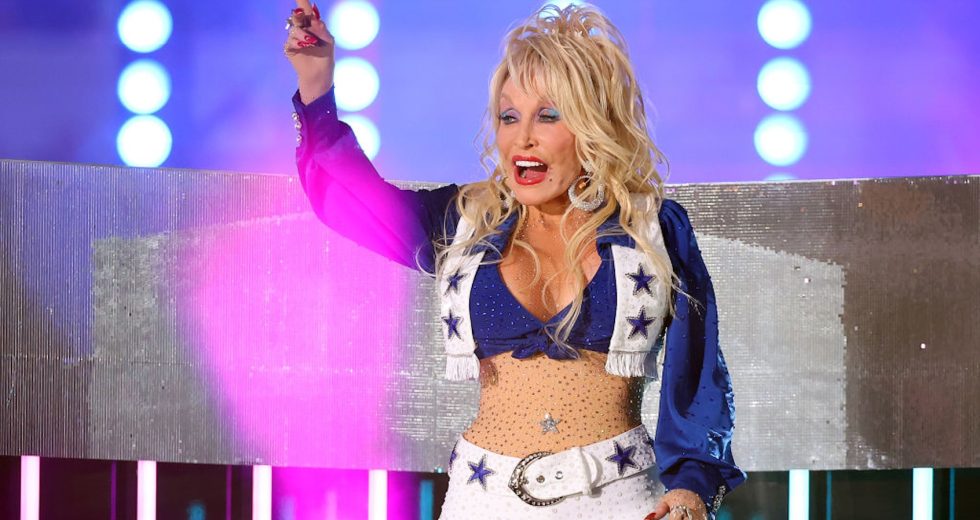
Dolly Parton made a lot of things across her 60-plus-year career: massive hit songs, a theme park, a children’s literacy initiative that gave away over 300 million books, movies of both the smash-hit and cult classic variety. But she shied away from making political statements.
This might seem like an odd thing to say about a country star whose coiffed blonde wig inched close to the heavenly host up until her death on Monday at 80, a down-home diva whose songs made her identifiable by just a mononym, whose blindingly bedazzled, highly structured outfits made her recognized by just her silhouette. Parton preferred to let her closet make the statements, while quietly building a kind of everybody-love-everybody progressivism that promoted equality and kindness while remaining mostly off-the-record.
In the public eye, Parton the person was always willing to take a backseat to her persona. She turned the “dumb blonde” assumptions on the audience, crafting a comedic alter ego that happened to share her name. Although it was Dolly Parton taking questions from late-night hosts in countless, breezy interviews, it was “Dolly Parton” answering. Dolly the character wasn’t taken seriously, and that steered interviewers away from asking her about serious topics.
Though she consciously and strenuously attempted to avoid labels like feminist and activist, Parton’s actions occasionally made her inner beliefs undeniable. She was writing songs in support of gay family members back in 1991, the first mainstream country artist to do so. She took a ride on the Magic School Bus in 1996 to stress the importance of recycling and environmental conservation. You can find her on the cover of Out Magazine in 1997, celebrating her legions of LGBTQ fans. Here she comes again, penning a song for the 2005 movie “Transamerica” that would go on to receive an Academy Award nomination. And there you go, trying to make the “love is love” ethos of her public persona into something like a personal politics.
But Parton could be hard to pin down. She’s the centerpiece of “9 to 5,” a movie about unionization and pushing back against workplace sexual harassment. If you somehow missed that star turn — her first — don’t worry; she sings the theme song. Still, she quickly shut down Elizabeth Warren’s presidential campaign in 2019 when they attempted to use “9 to 5” at rallies as a nod to the candidate’s pro-labor activism. Parton repeatedly refused to accept the Presidential Medal of Freedom from both Donald Trump and Joe Biden. Buried somewhere in her reasoning was likely something along these lines: “Dolly Parton” isn’t political, therefore Dolly Parton’s songs cannot be political.
The singer’s extensive philanthropic record mostly pushed the importance of literacy and higher education, a view that has been coded as left-of-center thanks to the actions of Republicans, who have spent several decades fleeing and sometimes sabotaging public education. Parton’s AIDS activism and LGBTQ advocacy puts her well to the left of the average MAGA fan socially. Despite this, she’s universally adored across the political spectrum. A poll released just this April found she had the highest favorability ratings of any American.
How was this country legend able to walk the line so deftly? Why was she able to work toward progressive goals without facing any backlash from conservative fans? And will any mainstream country star ever be able to avoid getting bogged down in culture war battles the way Dolly did?
That last question is the easiest and quickest to answer: No. The why is less simple.
Dolly was able to just be Dolly, in part, because of how long she’d been Dolly. She predated our overheated era of cable-news slapfights as a massive star and national treasure who never took herself too seriously.
Dolly was able to just be Dolly, in part, because of how long she’d been Dolly. She predated our overheated era of cable-news slapfights as a massive star and national treasure who never took herself too seriously. She was famously in on all the jokes about her. She launched her Imagination Library in the late 1980s, well before a time when a centralized charity sending out books directly to children would be subject to immense scrutiny, outside of fringe cranks on high alert for any whiff of a New World Order. Parton was cemented as an icon before two events turned country music stardom entirely on its head.
The Sept. 11 attacks and the advent of social media fundamentally changed the shape of country music and what it meant to be a chart-topper. The latter gave rise to the idea that fans had a right to know more about their favorite artists, up to and including where they stood on specific political issues. The former was the genesis of the Global War on Terror, an atrocity that drew a red line through American culture and bluntly asked a question familiar to Parton’s fellow Appalachians: Which side are you on?
In the aftermath of 9/11, country music radio became a font of rah-rah troop support and war-boosterism. As Lee Greenwood’s 1984 hit “God Bless The U.S.A.” returned to the chart, 1990s hitmaker Alan Jackson took a break from tender love songs to write a schmaltzy tribute to the lives lost at Ground Zero, the Pentagon and the field in Pennsylvania. Toby Keith drooled over artillery and warned “we’ll put a boot in your a*s, it’s the American way,” and Darryl Worley wrote propaganda pieces for the war’s expansion. The jingoism soon became all too much for The Chicks, the best-selling country band in recorded history, whose frontwoman Natalie Maines said during a London show kicking off the band’s “Top of the World” tour that she was “ashamed” then-President George W. Bush was from her home state of Texas. “We do not want this war, this violence,” she said, referring to the administration’s imminent plans to invade Iraq.
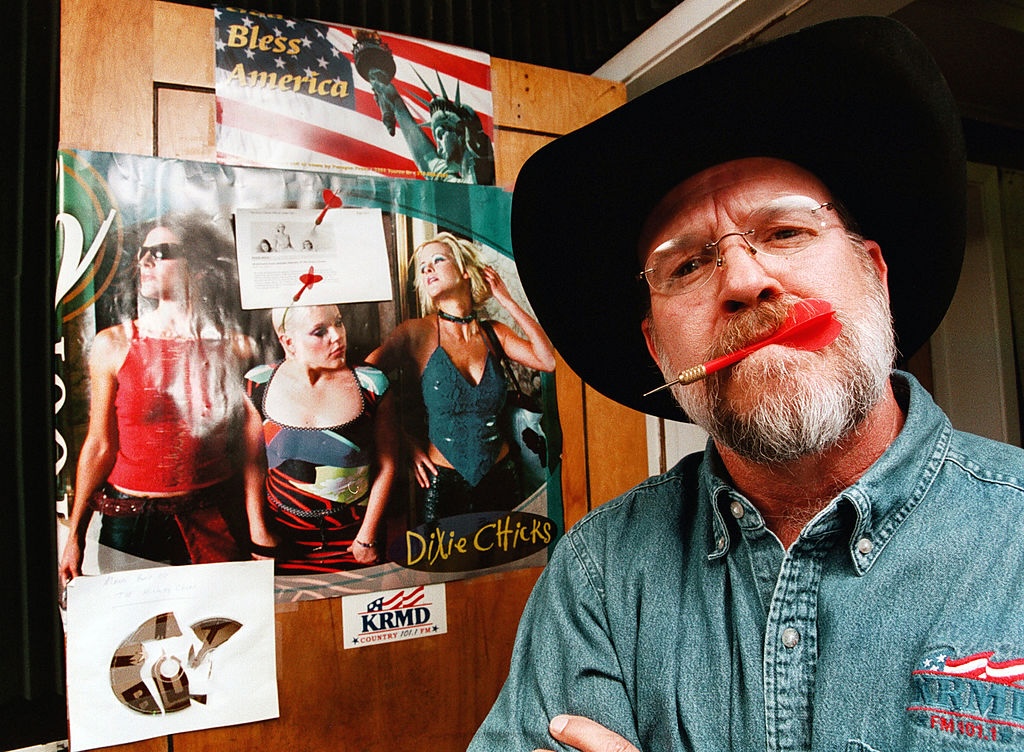
(Mario Villafuerte/Getty Images)) Shreveport, Louisiana, country radio personality K. C. Daniels turned a poster of The Chicks into a dartboard in March 2003 following lead singer Natalie Maines’ comments about President George W. Bush and Iraq at a concert in London.
The backlash was swift and immediate. Knee-jerk patriots who felt betrayed by these bluegrass traditionalists turned mega-stars crushed their Chicks’ CDs in public protests. They argued that Maines’ criticism, which came on foreign soil, was cowardly. Maines countered that she was responding to current events, but she apologized to the fans who felt hurt — and then she recanted. The Chicks’ songs were blacklisted on many country radio stations, and remained that way for years. While the band never wavered on their criticism of Bush, and even doubled down on it in their 2006 hit “Not Ready to Make Nice,” the message was clear to any acts without the mega-fame of The Chicks: Shut up and sing.
The resulting two decades of conservative, nostalgic hits on country radio have made Republican leanings cloaked in back-home nostalgia the default pose of country music’s A-list. At the same time, fan pressure to offer unambiguous political statements has grown.
Parton’s solo career spanned equally divisive times, launching at the height of the Vietnam War and carrying on for everything that came afterwards. But the assumption that she should have a stance on issues of the day was nowhere near as strong then. By the time social media made political heat checks commonplace, Parton was exempt from the demand for answers.
Start your day with essential news from Salon.
Sign up for our free morning newsletter, Crash Course.
Maybe it’s because journalists and fans knew what they would get. In a May 2023 interview with journalist Jacob Saboroff, she was asked about what could well be her most political song. “World on Fire,” she sang, “Greedy politicians present and past / They wouldn’t know the truth if it bit ‘em in the a*s.” Parton told Soboroff she was singing about “All of ‘em. Any of ‘em.”
“I don’t think any of ‘em are trying hard enough,” she said. “I’m sure we’re all trying, but I just really think often that they worry more about their party than they do about the people. If we just do what we felt was the right thing, rather than who’s going to lose, or who’s going to win this, or who’s going to look better if they do this. None of them are working from the heart.”
At the same time, allegations of GOP sympathies dogged country star turned pop icon Taylor Swift for years before she explicitly endorsed Democratic candidate Kamala Harris for president in 2024. If Zac Brown and Luke Bryan were going to turn the charts into troops salutes and MAGA boat parade soundtracks, then actual veteran Zach Bryan was going to have to go on the record with an anti-ICE track. Although Kacey Musgraves has singles in the Parton school of “let people live,” she doesn’t have the luxury of public neutrality that Dolly did.
Now even Dolly-esque clowning can’t save country music’s current stars from having to take unambiguous positions. In the music video for Musgraves’ recent single “Dry Spell,” she reflects on striking out as a single woman while ogling suggestively shaped produce in the grocery store. On her current tour, she descends to the stage on a pair of mirror-covered testicles, literal disco balls. Still, when she speaks out in support of American immigrants as one of the genre’s most prominent progressives, she’s branded a traitor by conservative country fans. Musgraves’ fanbase wants her to speak up, if only to distance herself from the MAGA-until-proven-otherwise pack, but doing so is risky and messy.
No such backlash came for Dolly when she spoke out against Tennessee’s anti-trans laws or in support of the George Floyd protests. She was able to hold a consistent “play nice” line because of her unassailable career and how long she’d been at it. It’s a stance that wouldn’t be allowed from anyone but Dolly, and one that will now almost certainly never be accepted again. Like her rise from the deepest rural poverty to beloved multi-millionaire, it’s one more yet part of her story that is entirely singular.
Read more
about country music
Source link