The Merikins are the descendants of formerly enslaved African Americans who fought alongside the British during the War of 1812. At the war’s end, the British granted these fighters and their families land in Trinidad and Tobago as part of their freedom.
The third verse of the “Star-Spangled Banner” served as a threat to African Americans who sought liberation — particularly those fighting against the United States like the Merikins — from Francis Scott Key, an unabashed racist whose racism influenced his professional legacy.
After years of playing it at sporting events out of choice or paid patriotism, Colin Kaepernick refused to stand for it:
“I am not going to stand up to show pride in a flag for a country that oppresses Black people and people of color . . . There are bodies in the street and people getting paid leave and getting away with murder,” Kaepernick told NFL Media in an exclusive interview following his now-infamous kneel.
Following a lengthy and seemingly self-imposed silence, as others sought to narrate his protest and commitment to social justice, Kaepernick has reemerged in the public square on an impressive press run promoting his book, “The Perilous Fight,” to whoever will listen, including the platforms of Karen Hunter, Katie Couric, Van Lathan, Trevor Noah, and “The View.”
Following a lengthy and seemingly self-imposed silence, as others sought to narrate his protest and commitment to social justice, Kaepernick has reemerged in the public square on an impressive press run promoting his book, “The Perilous Fight”
Kaepernick’s book discusses his life up to this point, from his childhood and adolescence to his current justice activities and life with his wife, Nessa Diab, and daughter. He takes time to explain the multifaceted origins of his activism, from the challenges of being a Black boy raised by white parents, to his experiences as a Black athlete in a space predicated on controlling Black bodies, to his awakening through literature by Black scholars and activists.
But like many Black people who were awakened by the murders of Black people by the police, Kaepernick was alarmed by the December 2015 murder of Mario Woods by San Francisco police. For refusing to drop his knife, Woods was shot twenty times by police. Police justified the killing, saying they feared for their safety, but the body camera footage said otherwise.
Kaepernick watched the Mario Woods video at his parents’ home, as his mother questioned Woods’ role in his murder. Upon reflecting on his attempt to explain to her the gravity of the situation and her lack of response, Kaepernick gained clarity:
“. . . the encounter helped bring even more clarity to the last twenty-eight years of my life, and why I was always frustrated and unsatisfied during my childhood when issues concerning race arose,” Kaepernick writes. “It was obvious my parents loved me as their son, but accepting their son was Black and dealing with that reality was not of much concern. Hell, I had white boys call me ni**er and try to tie me to a tree, yet I never told my parents. Even my mother told me I looked like a thug when I wore cornrows.”
When it was time to take a stand for Black people, he didn’t ask for permission, because he was already empowered to do so. And a Black athlete empowered to stand for Black people is an athlete who should expect to be persecuted.
Woods’ murder, followed by the murders of Alton Sterling and Philando Castile, and the not-guilty judgment for the officer who murdered Freddie Gray, compelled Kaepernick into protest at the start of the 2016 NFL season. While Kaepernick’s protest garnered acknowledgment and some support, it also led to his banishment from the NFL and the hijacking and appropriation of his protest, along with critique and ridicule of perceived inaction.
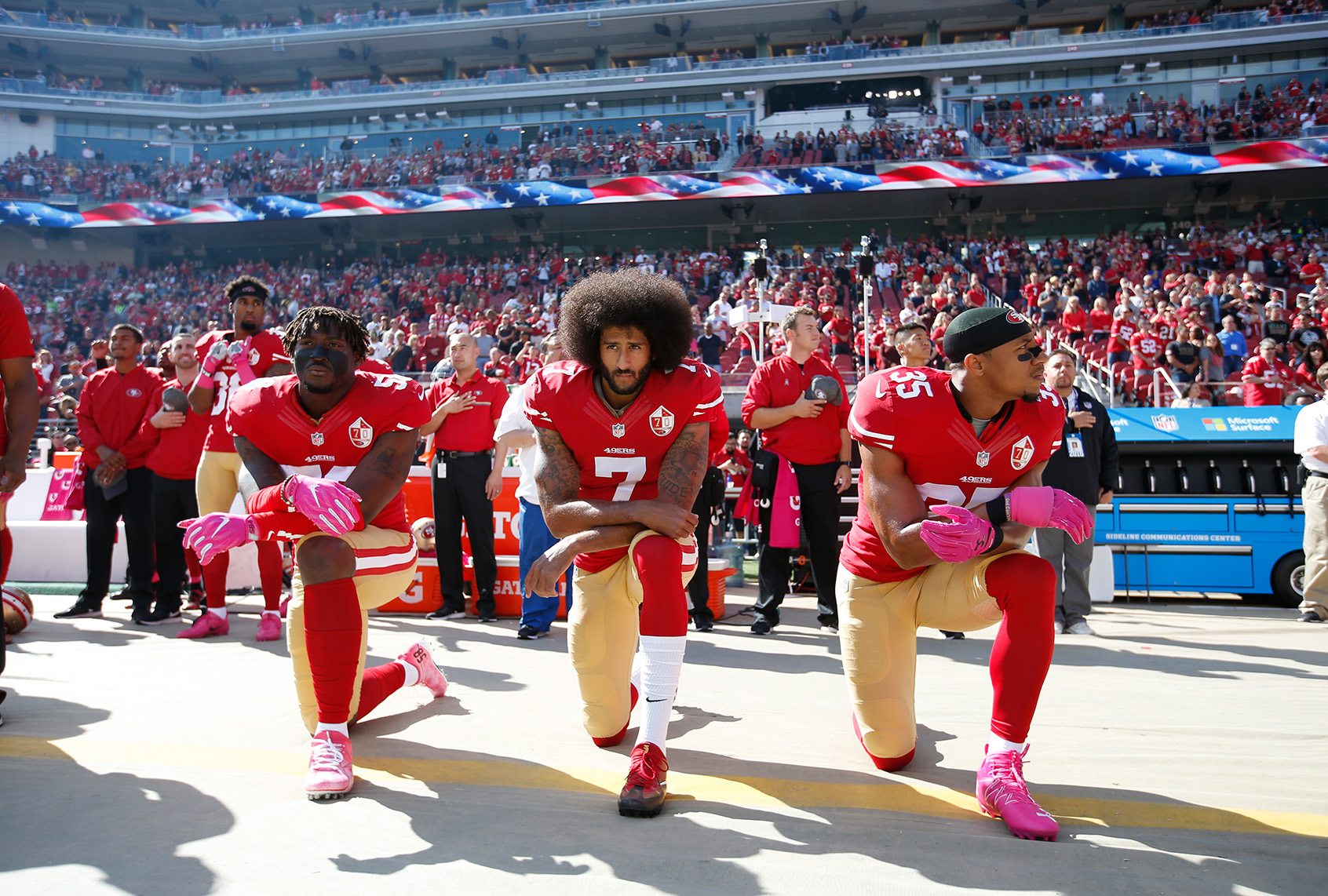
(Michael Zagaris/San Francisco 49ers/Getty Images) San Francisco 49ers players Eli Harold, left, Colin Kaepernick and Eric Reid kneel during the national anthem before a game in Santa Clara, California, on Oct. 23, 2016.
But Kaepernick pursued racial justice work: from the Know Your Rights Camps (KYRC) to the KYRC Autopsy Initiative, both founded with his wife and partner, radio personality Nessa Diab:
“I was hearing criticisms accusing me of just being an angry Black man without a plan. I wanted to buttress my protests on the field with action on the ground, to build an infrastructure that could start effective change where it might make a difference . . . I didn’t want to look back on this time and agonize that I should have and could have done more.”
Equally fascinating was his pulling back the curtain, so to speak, on the culture of football, particularly the NFL, where the expectation for players is to follow orders and “shut up and play.” He explained this by detailing various interactions with teammates, coaches, team executives, and even sports agents.
“Football breeds a culture of obedience. On the field, these guys were major alpha males — the biggest, baddest, most dominant dudes on the planet. But once they stepped off the field, they were just employees waiting for the boss to tell them what to do.”
Want more from culture than just the latest trend? The Swell highlights art made to last.
Sign up here
But the culture of the league also forced him to examine the implicit racism as early as his participation in the NFL Combine, asking himself, “Do all of those A’s over sixteen years of schooling plus the 3rd highest grade on the Wonderlic not mean anything? Is their stated concern over my intelligence genuine, or is there something . . . having to do with racist stereotypes?”
While all his experiences up to 2016 were instructive, they couldn’t buffer the shock and disgust of the backlash to his protest. While he did receive support, he couldn’t anticipate Nate Boyer’s attempts to profit from the protest and steal credit from Kaepernick teammate Eric Reid for the idea to kneel. Kaepernick couldn’t anticipate the Islamophobia and misogyny aimed at his wife. Nor could he anticipate the president of the United States calling him and his colleagues “sons of bit*hes.”
Who could possibly be prepared for any of that? Then again, maybe Kaepernick should have been.
All skinfolk ain’t kinfolk, and if he wasn’t aware before the protest, he certainly is now.
His two near-death experiences made him fearless. Overcoming numerous challenges in his football career made him steadfast. Welcoming his wife into his life, and the growth that came with it, grounded him. His childhood experiences with whiteness shaped him. Therefore, when it was time to take a stand for Black people, he didn’t ask for permission, because he was already empowered to do so. And a Black athlete empowered to stand for Black people is an athlete who should expect to be persecuted, like Curt Flood, whom Kaepernick mentioned.
His protest didn’t make white people comfortable. There were no performative photo-ops with politicians or any ride-alongs with police. There was confrontation. I suspect he anticipated some of the whitelash. After all, Kaepernick didn’t appear shocked that his white family was embarrassed by his protest, with his mother calling it “disgraceful.” What he may not have anticipated was the extent of the cover Black players and notable Black folks gave the NFL.
I wonder if Kaepernick anticipated hearing a player tell him he needed “to go ask my owner if it’s okay to protest.” Did he anticipate Dr. Harry Edwards being co-opted by the 49ers, Ray Lewis by the Ravens, and the players’ coalition by team owners? Did he anticipate Michael Vick suggesting that he cut his hair to get a job in the NFL? Did he anticipate being sold out by Jay-Z for personal gain, followed by hit pieces and being dissed in a freestyle many years later?
The truth is that all skinfolk ain’t kinfolk, and if he wasn’t aware before the protest, he certainly is now.
But Kaepernick doesn’t leave readers feeling that his work was in vain, or that he is without hope. He shares that his family, his wife and daughter, provide him with a newfound motivation to make justice a reality for Black people and all other people of color. He closed his book saying, with a Clarion call of sorts to his readers:
“Our children can’t develop to their full potential if they are constantly worried about what awaits them outside the doors of their home, or if they are on edge because of the fear of ICE agents invading their schoolyard or playground . . . What are we doing to our nation’s children when we are constantly undeserving their needs and sending them into schools that feel like war zones? They can never reach their peak in such circumstances. We must consider these factors when we think about how we are policing our communities and educational environments. We all want the same things for our children.”
But it begs the question that we all must answer: We all want the same things for our children, but do we all want the same things for each other? Colin Kaepernick has decided to move forward in hope. He’s asking us to do the same.
Read more
about this topic
Source link