Recently, I learned about a concept called atomic change. The term’s meaning depends on who’s employing it. One professional coach’s website describes it, in so many words, as making discrete adjustments to a business that, over time, lead to its significant transformation.
An engineering professor defines it as “a change applied to a class definition (i.e., its source code) such that a) it is minimal (cannot be decomposed into other atomic changes) and b) the program compiles and builds after the change.”
Then we tumble into the realm of inspirational gurus and thought leaders, where breathwork and manifesting meet motivational speak, popping with familiar verbal kernels like “sparking joy” and “habit formation.” It all reduces to the promise of small daily actions that, over time, build into the conquest of your wildest dreams.
Notice how similar the programming instructions are for computers, systems and people. Atomic change suggests that the soul, like the mind, can be reconfigured as gradually as we might update a laptop one key and chip at a time. That premise — that people can be gradually reconfigured — is one Oprah Winfrey discovered four decades ago when she launched the syndicated talk show that would change daytime TV, “The Oprah Winfrey Show,” on Sept. 8, 1986.
Who and what we read is shaped in no small part by Winfrey. Somewhere in your house probably lurks a book, an accessory or an appliance you may not have bought if Winfrey hadn’t given it her seal of approval.
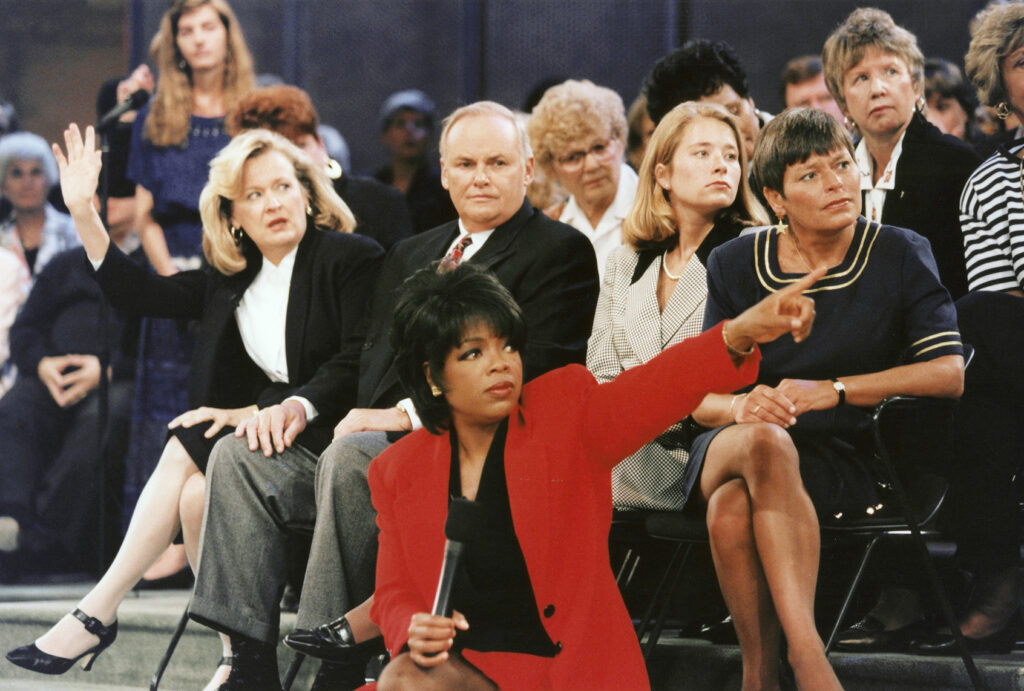
(George Burns / ©Harpo Productions / Courtesy Everett Collection) Talk show host Oprah Winfrey points to an audience member during a taping of “The Oprah Winfrey Show” in 1996.
Even if that isn’t the case, the ramifications of two Oprah Winfrey endorsements touch every American: It’s unlikely the names of Dr. Mehmet Oz and Dr. Phil McGraw would have floated into Donald Trump’s orbit otherwise. Since Winfrey anointed them as her go-to experts on wellness and behavioral health, Trump added them to his ineffectual celebrity governing cabinet. Dr. Oz leads the Centers for Medicare & Medicaid Services.
Dr. Phil, America’s pro bono therapist, is now the celebrity face of Trump’s Religious Liberty Commission. In 2025, after previously embedding with Immigration and Customs Enforcement during raids in Chicago, his MeritTV crews were on the ground during ICE operations in Los Angeles. Merit Street Media, the television network he launched around MeritTV, later filed for bankruptcy protection.
This is what it means to spend 40 years being America’s original influencer.
Some may take issue with likening Oprah Winfrey to J. Robert Oppenheimer, the father of the atomic bomb. If this is the only way you view him, I suppose that’s fair. But remember that before Oppenheimer tossed us into the nuclear age, he pioneered modern theoretical physics in the United States. Some of his initial investigations contributed to our understanding of neutron stars and black holes.
We often associate him with the scriptural quote from the Bhagavad Gita that reads, “Now I am become Death, the Destroyer of Worlds.” Not many recall his reported invocation of another work of Sanskrit poetry that reads, “In sleep, in confusion, in the depths of shame/The good deeds a man has done before defend him.”
A similar tension shadows how we reconcile what Winfrey means to American culture.
Over the years, Winfrey gave us many nice things. She was the first daytime host to bring New Age, self-help philosophies to a massive audience under the rubric of “Change Your Life TV” while also making literacy fashionable via “Oprah’s Book Club” and promoting feel-good consumerism.
Through her encouragement, reading became a social, communal activity and positively relating to one another part of a purpose-driven existence. Along those lines, “Oprah” raised the profiles of many figures, including life-fixer Iyanla Vanzant and interior designer Nate Berkus, who reframed homekeeping as house pride. Even Winfrey’s movie career is largely comprised of roles that originated in books and ideas that spoke to her on a deep level, including her turns in Toni Morrison’s “Beloved” and Alice Walker’s “The Color Purple.”
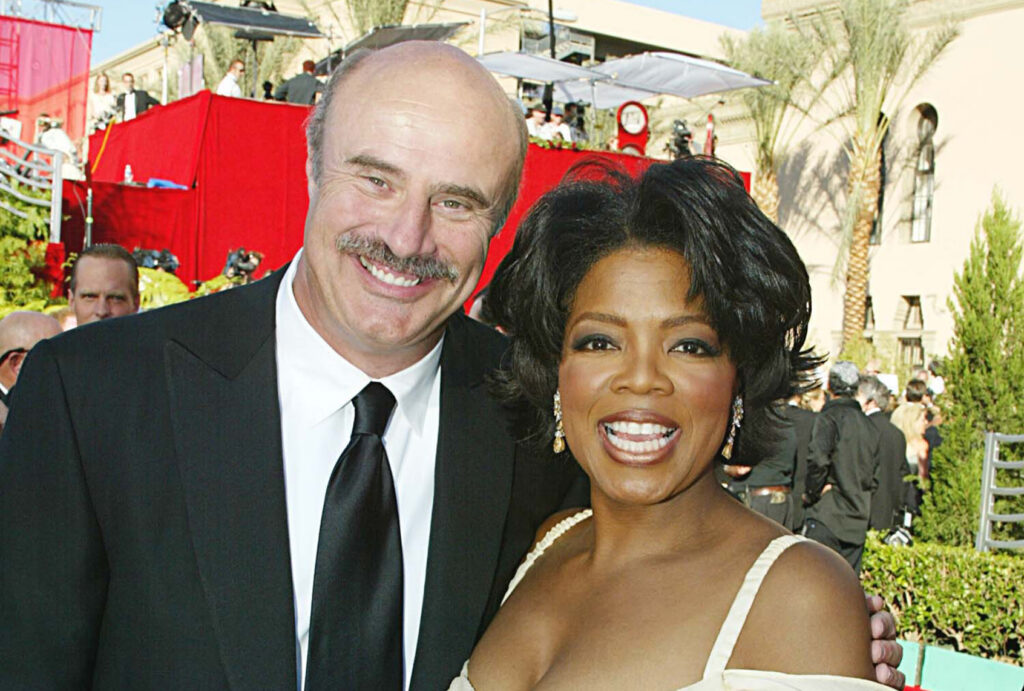
Phil McGraw and Oprah Winfrey at the 54th Annual Primetime Emmy Awards in Los Angeles on Sept. 22, 2002.
But if it feels like “The Oprah Winfrey Show” remains a present force despite Winfrey ending her show 15 years ago, that is because it lives on through hundreds of self-made influencers. Instagram and TikTok are awash in smiling people reminding their followers that they are worthy and loved; that they do not have to put up with abuse or maltreatment; and that they deserve to treat themselves to subscriptions of life-changing supplements, beauty products and meal kits of their choice. Link in bio!
A few, such as Jay Shetty and Alex Cooper, have amassed enough of an audience to build media companies around themselves and their brands – which are essentially one and the same. Of course, they are not billionaires like Oprah or celebrities like Gwyneth Paltrow or Reese Witherspoon, who leveraged their pre-existing stardom into profitable imprimaturs in wellness and publishing.
But as Dr. Oz and Dr. Phil continue to embarrass themselves publicly, some wonder what responsibility Winfrey feels for making them famous. A recent interview with veteran critic Eric Deggans in Emmy magazine answered that question definitively.
“Everybody has their own path in life, and it has not one thing to do with me, and I don’t have one thing to do with them,” she said. On its own, that may read like spiritual bypassing. In the context of what she stated before that, however, it makes sense: Winfrey said McGraw helped her through a challenging time when, in 1998, she was accused of defaming the beef industry and sued by Texas ranchers. She found that Oz had a gift for explaining preventive medicine to ordinary people.
“At the time, the reason and intention behind me giving them their breaks was I thought they had valuable information to share that had been meaningful to me,” she explained.
Thus, the conundrum of Winfrey’s terribly consequential influence.
Long before Oz entered politics, for example, he’d been discredited for dispensing a vast array of scientifically unsound medical advice on “The Dr. Oz Show,” which Winfrey’s Harpo Productions co-produced. Nobody forced viewers to follow his unsound prescriptions.
The fact that many did makes one wonder how much sway Dr. Oz and Dr. Phil would have if our healthcare system didn’t relegate women to second-class status — and women of color even lower still — and placed behavioral and psychological wellness on par with other preventative care.
Let’s not discount America’s addiction to purchasing shortcuts for happiness either, which Winfrey also knows very well. Nine years ago, she included a Gratitude Jar on her annual Oprah’s Favorite Things list, which included nothing but 365 blank cards and vibes. It quickly sold out. That’s right: Oprah Winfrey persuaded her followers to buy a cylindrical glass container holding paper and air, for $45.
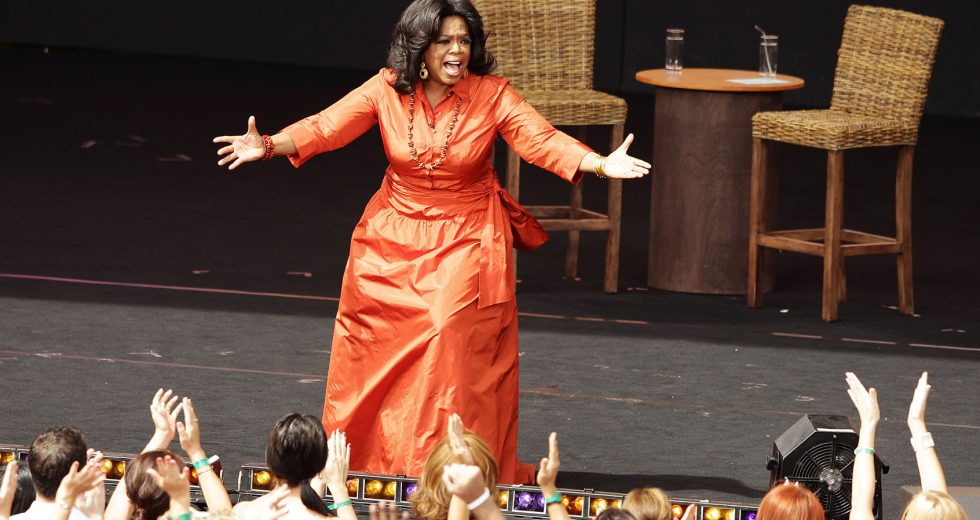
But I get it now. Winfrey was the first TV personality to invite a loyal audience primarily made up of harried women to put themselves and their care first. Over 25 years and 4,561 episodes, each of her small suggestions compounded into massive cultural shifts — significant transformation, from which there’s no going back.
Read more
about this topic
Source link