At the end of the debut episode of “The Real Food Show,” Robert F. Kennedy Jr. spears a single bite of salmon cake and brings it to his lips. “Amazing,” he says, giving chef Andrew Gruel a slack thumbs-up. The salad on the plate — arugula, white beans and sliced apple — remains untouched. Kennedy does not go back for another bite.
“Thank you,” Gruel replies. “First time I’ve cooked for a dignitary.” Kennedy pats him quickly on the back, then turns to the camera. “We’re here today to teach Americans how to eat real food, high-quality food at affordable prices,” he says, “and we’ll see you next time.”
The bite, it turns out, was less a culmination than an exit cue.
This is the central uncanniness of “The Real Food Show,” which contains all the familiar furniture of a cooking program — the studio kitchen, the chef, the recipe, the price graphics, the ceremonial final bite — but almost none of the curiosity or pleasure that ordinarily gives the form life.
Food is everywhere, but appetite is nowhere.
Officially, “The Real Food Show” is a new HHS cooking series intended to bring the Dietary Guidelines for Americans to life through affordable recipes, easy techniques, practical nutrition advice and special guests preparing their “healthy signature dishes” alongside Kennedy.
(Kennedy is not, apparently, the only member of President Donald Trump’s Cabinet to have recently heard the siren call of the web series. In May, Transportation Secretary Sean Duffy announced “The Great American Road Trip,” a family travelogue starring Duffy, his wife, Rachel Campos-Duffy, and their nine children. It was supposed to premiere in June; as The Bulwark’s Will Sommer noted this week, August arrived without a single episode. Kennedy may, for now, be the only Cabinet host who has actually managed to get his show on the air.)
The premiere opens with Kennedy standing inside a low-budget digital cornucopia. A red cartoon hunk of steak, a bronzed turkey, a few shrimp, a tub of unsweetened yogurt, an apple and a bag of frozen peas cascade alongside him. The show keeps insisting on “real food” while representing it through some of the fakest, cheapest-looking imagery available.
Want more great food writing and recipes? Sign up for Salon’s free food newsletter, The Bite.
Thanks to President Trump, Kennedy announces, “we’ve flipped the food pyramid and put real food back where it belongs, at the center of the American plate.” He plans to travel across the country showing families how to cook delicious, nutritious meals with real ingredients at affordable prices. At the word “affordable,” a blizzard of dollar bills begins to fall behind him.
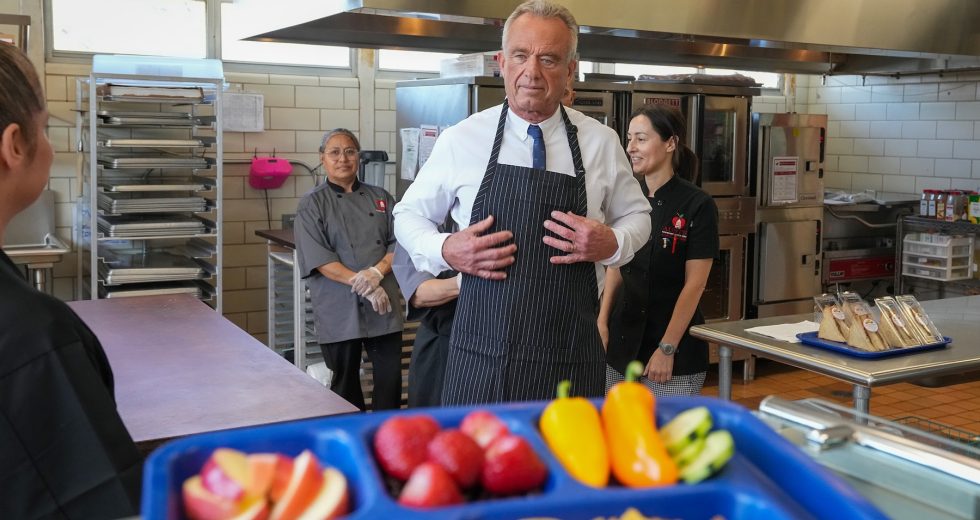
The digital collage gives way to a more familiar cooking-show fantasy. Kennedy joins Gruel — a chef, restaurateur and prominent opponent of COVID-19 restrictions in 2020 — in a bright white studio kitchen. They wear matching “The Real Food Show” aprons. Behind them, cookbooks line the shelves, fruit has been arranged decoratively across the counters and every surface gleams with aspirational domestic ease. The set, at least, knows exactly what a cooking show is supposed to look like.
Gruel begins with an entirely reasonable proposition. The ingredients will be familiar to home cooks, he says, but he will introduce a few “cheffy tricks” along the way.
Before much cooking can occur, however, Gruel explains that many Americans are addicted to processed foods because those foods have been chemically engineered to be addictive. With a few whole ingredients, he says, they can make something just as delicious. This, too, is familiar enough advice. What is strange is the air of grim discovery around it, as though the pleasures of cooking with recognizable ingredients had only recently been recovered from a hostile laboratory.
Gruel selects seafood, one of what he calls the country’s “bounty items,” and announces that they will make salmon cakes. The recipe calls for a pound and a half of frozen salmon; an on-screen graphic prices it at $8.99, without naming a retailer or indicating that the fish is on sale. When I checked my local Mariano’s in Chicago, the same amount, even at its sale price, came to about $12. The difference is not ruinous, but it is the first indication that the show may be playing loosely with its promise of meals costing less than $5 per serving.
Gruel notes that home cooks can use another kind of fish, even canned fish — useful, flexible advice that is also so broad as to become generic. Rather than explain how a leaner fish or one packed in oil might change the cake, the recipe simply expands to encompass nearly anything.
There is a brief detour about frozen salmon. Gruel explains that freezing fish kills parasites. Kennedy listens attentively. Given the secretary’s own much-discussed brain-worm story, the moment lands like a joke no one on set appears to notice.
The salmon goes onto a sheet pan. In the kitchen, Gruel recommends rubbing it with avocado oil, salt and fresh herbs. The accompanying graphic quietly offers two additional fats: olive oil and beef tallow, the latter a favorite within the administration’s anti-seed-oil discourse. Viewers are then instructed to roast the fish at 400 degrees for eight minutes. There is no meaningful guidance about the thickness of the fillets, the temperature they should reach or how to tell when they are done.
Yet, the salmon reappears cooked and cooled. Before the hosts can begin flaking it, however, the show pauses to consider why Americans eat so little fish compared with people in Japan.
Kennedy suspects the difference is cultural: In the United States, he says, people tend to think of meat when they think of protein.
It is a curious diagnosis from an administration whose senior officials have lately been swapping notes on a regimen nicknamed the “sauerkraut diet.” Kennedy and several other Cabinet members have reportedly embraced versions of the plan, which emphasizes grass-fed meat and fermented foods while eliminating alcohol and sugary foods. The physician behind it advertises direct consultations costing as much as $18,000. The show, meanwhile, suggests that ordinary Americans priced out of meat try fish — any fish, even canned.
The advice is useful. The asymmetry is difficult to miss.
Then, at last, they cook together. Kennedy flakes the cooled salmon into a metal bowl while Gruel adds an egg, panko, Dijon mustard, chopped red onion, chives, nutritional yeast and avocado-oil mayonnaise. Small price graphics pop up beside the ingredients as they go: 25 cents for the egg, another modest sum for the breadcrumbs. Gruel talks Kennedy through the mixture, offering the kind of loose, adaptable instruction home cooks have received from television chefs for decades.
The recipe proceeds in the key of perfectly fine. The ingredients are accessible, the substitutions sensible, the salmon cakes plausible weeknight fare. The show’s strangeness does not arise from strange cooking advice, but from the ideological burden placed upon it: An ordinary fish cake becomes evidence that Americans might eat their way toward a healthier, more fiscally disciplined nation.
It’s time for a side.
First, however, Kennedy pauses to relitigate the federal government’s recent nutrition policy. The Biden administration’s dietary guidelines ran 453 pages, he says, with the number offered as self-evident proof of their absurdity. His department threw that work “in the trash,” assembled a new group of nutritionists and, he jokes, locked them in a room for 11 months to produce recommendations actually grounded in science. For decades, Kennedy says, the government has lied to Americans about saturated fat.
When the cooking resumes, several salmon cakes have already been shaped and set aside. Gruel explains that resting allows the panko to absorb moisture, though he does not say how long that takes. The finished cakes are browned and appealing.
Pleasure is never quite sufficient justification for cooking something yourself; the viewer must also understand that the old version was artificial, addictive or imposed upon them by a corrupt system. Even the vinaigrette arrives as evidence in a case.
The side dish is a salad of apples, white beans and greens with a simple vinaigrette. Gruel recalls growing up in what he calls the “microwave generation,” in a house stocked with cereal, pasta, refined carbohydrates and premade salad dressings. He describes himself as having been “addicted” to them. Making your own dressing, he says, is one of the easiest ways to improve your cooking.
He is right. Homemade vinaigrette is quick, inexpensive and generally much better than the bottled kind. But “The Real Food Show” cannot recommend a salad dressing without first convening a tribunal. Pleasure is never quite sufficient justification for cooking something yourself; the viewer must also understand that the old version was artificial, addictive or imposed upon them by a corrupt system. Even the vinaigrette arrives as evidence in a case.
That moral framing has consequences beyond the kitchen. “The Real Food Show” never explicitly argues that a salmon cake can replace a social safety net. Some viewers, however, appear ready to complete the thought. “Exactly the type of videos a HHS secretary should be posting,” one commenter wrote. “Good food = Good health = Drastically reducing healthcare budgets.”
It is only one comment, not an official statement of policy. But it articulates the logic hovering around the episode: If Americans can be taught to eat correctly, perhaps they will require less care — and perhaps the government can spend less providing it. That implication is particularly grim after Trump and congressional Republicans enacted legislation projected to reduce federal Medicaid spending by nearly $1 trillion over a decade and leave over 10 million more people uninsured in 2034. The same law is expected to cut federal SNAP spending by roughly $187 billion through expanded work requirements, narrower eligibility and new costs for states.
None of this makes the show’s basic proposition false. Nourishing food can support good health, and learning to cook can make daily life cheaper, easier and more pleasurable. But nutrition instruction cannot substitute for the money, time, access and medical care required to follow it. The kitchen can do many things. It cannot absorb the obligations of the state.
Back in the studio, the final stretch is the show at its most conventionally useful. Gruel demonstrates a knife-sharpening technique, assembles the salad and plates the salmon cakes. Even with Kennedy looming over the counter more than sous-cheffing beside it, “The Real Food Show” briefly becomes the cooking program it has been dressed to imitate.
Then comes the first and final bite. Kennedy takes a stab at the salmon cake, brings one bite to his mouth and calls it “amazing.” He offers Gruel a lazy thumbs-up, accepts the chef’s joke about cooking for a dignitary and immediately turns to the camera to recite the show’s mission statement.
After an episode filled with warnings about addiction, government deception, processed food and discredited fats, the meal itself receives one adjective and one bite. Kennedy does not remark on its flavor or texture. He does not try the salad. He does not return to the plate.
The food has already performed its function. Nobody has to want a second bite.
Read more
from Ashlie D. Stevens on food and politics
Source link