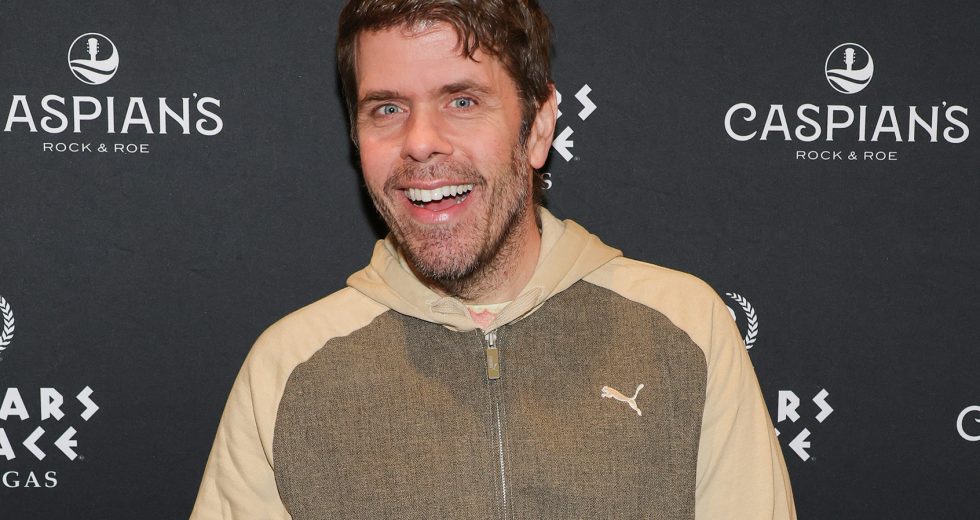
Perez Hilton always wanted to be famous. This is a statement of fact and not meant to make light of his self-harming incident broadcast via TikTok livestream on Tuesday—quite the opposite. Videos and images of Hilton, 48, covered in blood and cutting himself with a knife should be interpreted as a cry for help, not attention. A person can understand that much without seeing the footage.
But many who watched didn’t have a choice. Although Perez’s livestream proceeded for around 15 minutes before it was shut down, screenshots and clips rocketed across the internet, invading countless social media feeds. Some saw those disturbing images simply by picking up their mobile devices.
Fortunately, Hilton was transported from his Miami home to a hospital to receive medical attention, according to the local sheriff’s office. But such incidents have become increasingly commonplace to the point of numbing us.
While Wednesday morning Google search trends data showed that people were hunting for images of Hilton, I went to YouTube to see what he was up to in 2002. That year, he starred in a short film called “Dating Up,” which is not listed under his IMDb or Wikipedia filmographies.
He describes it in the video summary as “A short film about gay dating. In a world before Grindr!” It’s also a glimpse of the time before YouTube, Facebook, Instagram and TikTok, and before the man born Mario Armando Lavandeira Jr. launched PerezHilton.com in 2004 and quickly became one of the world’s most popular, controversial and despised gossip bloggers.
I chose 2002 because that year’s most famous video captured the Feb. 1 execution of Wall Street Journal reporter Daniel Pearl. Footage of his beheading circulated in the bowels of the internet for months, until the now-defunct Boston Phoenix published a link to it on its website, igniting furious debates about the morality and journalistic ethics of that decision.
Such discussions seem quaint in an age in which the video of Charlie Kirk’s assassination was posted to social media moments after it happened, and a gunman in Christchurch, New Zealand, livestreamed his killing of 51 worshippers at two mosques on Facebook.
An age, it bears adding, when X and Meta—Facebook and Instagram’s corporate owner—no longer emphasize stalwart moderation guardrails in the name of reducing “censorship” on their platforms.
The circumstances leading to Hilton’s distressing livestream and Pearl’s filmed execution are entirely dissimilar. But what brought the 2002 video to mind was that it marked the first time in modern history, at least that I can remember, that the public questioned what purpose watching something too horrible to fathom ultimately serves. Such discussions helped establish the difference between witnessing as a matter of civic responsibility and leering voyeurism.
Images of Sept. 11, 2001, were still fresh and traumatizing for millions who watched the World Trade Center’s Twin Towers collapse on live TV when Pearl was murdered.
But his death was an intimate injury to his loved ones first and foremost. Making it public, therefore, was viewed as a ghoulish act by many, including Salon’s former national correspondent Bruce Shapiro. “The idea that tossing the desires of Pearl’s family into the ashcan is ‘just what journalists do’ is only a cover for indiscriminate National Enquirer logic,” he said in a June 2002 column.
Months after that, the Phoenix’s media critic Dan Kennedy contended that it is our obligation to watch such difficult accounts in an essay for Harvard’s Nieman Foundation. “We turn away from such evil at our own peril,” Kennedy maintained.
The twin forces of cellphone footage and instantaneous social posting have long cultivated what is now understood to be a society-wide problem: the separation between the reality unfurling mere feet in front of us and the filter provided by electronic screens and lenses.
Somewhere in the middle, the rest of us wondered how absorbing such horror would change us, whether as individuals or as a society.
Twenty-four years ago, it was very easy to turn away from something you had to go digging for in the first place. YouTube would not exist until 2005. Instagram’s founding happened five years after that. TikTok turns 10 this year.
In the years between those companies’ founding and now, social media has given us plenty of opportunities to take up those debates again. But when such content is widely available, and we have so little choice as to whether we can avoid it, conversations about the ethics of it all seem like a luxury.
In exceptional cases, disseminating footage that’s hard to stomach serves a noble objective. Graphically violent video pouring out of 2011’s Arab Spring uprisings opened the world’s eyes to the deadly state violence people suffered under the repressive regimes of Tunisia, Yemen, Egypt, Libya, Syria and other Arab nations.
In the United States, bystander videography has been bringing incidents of police brutality into American living rooms since at least 1991, when Los Angeles resident George Holliday captured cops viciously beating Rodney King on videotape. But the first cellphone equivalents to go viral were the 2009 videos of a police officer fatally shooting 22-year-old Oscar Grant III in the back at Fruitvale Station in Oakland.
And the list of people whose last living, breathing moments were captured on cellphone videos and shared with the world has only gotten longer. In 2014, the nation watched Eric Garner suffocate to death as a New York City police officer subdued him using a prohibited chokehold. In 2016, Diamond Reynolds filmed the moment that a police officer shot her boyfriend Philando Castile to death during a traffic stop in the Minneapolis-St. Paul area and posted it to Facebook Live.
In 2020, 17-year-old Darnella Frazier recorded Minneapolis cop Derek Chauvin kneeling on George Floyd’s neck for more than nine minutes. And earlier this year, multiple bystanders recorded the shootings of Minneapolis residents Renee Good and Alex Pretti, footage that contradicted Trump administration officials’ claims that Good was a “domestic terrorist” and Pretti was an “assassin.”
In all those incidents, bearing witness galvanized the public. The international furor over Floyd’s death sparked nationwide protests and briefly mainstreamed the Movement for Black Lives. Videos of Good and Pretti’s killings by Immigration and Customs Enforcement agents turned all eyes to Minnesota, leading to the ouster of Kristi Noem from the Department of Homeland Security.
At the same time, our social media algorithms were not as loosely regulated a decade ago as they are now. Teams of human moderators once employed by all the major platforms have been gutted. Nobody should be shocked to know that the easiest place to find Hilton’s self-harm videos is X. As for TikTok, a spokesperson told the Los Angeles Times on Wednesday, the platform relies on automated moderation systems. They flagged Hilton’s alarming livestream within minutes, closed other live streams within 90 seconds and banned the account, the spokesperson said, but its removal was delayed by what was characterized as “a moderator error.” (TikTok previously banned Hilton in 2020 for violating its community guidelines. At the time, his account had 1.6 million followers and averaged 10 million views per week.)
Want more from culture than just the latest trend? The Swell highlights art made to last.
Sign up here
The twin forces of cellphone footage and instantaneous social posting have long cultivated what is now understood to be a society-wide problem: the separation between the reality unfurling mere feet in front of us and the filter provided by electronic screens and lenses.
Knowing this, the fact that the top search terms on Wednesday morning indicated that people were looking for images of Hilton’s self-harm instead of contextualizing reporting is telling but, sadly, not surprising.
Lurid real-world footage of people harming others or themselves is being served directly to us whether we want to see it or not. What we might debate, as we did 24 years ago, is what that’s doing to us.
Read more
about this topic
Source link